

Revisiting Chrissie Hynde and The Pretenders
It was the summer of 1984. I was playing pinball with a pal at Tiffany’s, a crowded pub on Ford Parkway in St. Paul favored by students from two nearby Catholic colleges, St. Catherines and St. Thomas. As an interloper from protestant (agnostic, really) Macalester College, I was on foreign territory, but Tiffany’s had our favorite pinball machine, so we occasionally ended up there.
As we played, from across the noisy barroom I heard a new song playing on the jukebox. I couldn’t hear it clearly through clamor, but what I could make out riveted my attention. It’s happened to me only a few times: I hear a pop song for the first time and know instantly that it will be a monster hit. I had that flash of recognition, for example, the first time I hear Soft Cell’s “Tainted Love,” The Kinks’ “Come Dancing,” and Lorde’s “Royals.” And it happened that night: George Harrison had, I was sure, just released his best-ever post-Beatles single.
A few days later I would learn the title of the song: “Back on the Chain Gang.” Of course it wasn’t by George Harrison, as I mistook it through the noisy din of the bar that night, but rather The Pretenders. And it did go on to become an enormous hit, just as I had intuited. I only recently learned that George Harrison too heard something of himself in the record: in a 1992 interview, he said it was the only other song he know that used a special chord, an E7th with an F on top, that he had invented for the Beatles’ “I Want You (She’s So Heavy).”
Then it was the summer of 2024. I started thinking about that song again because on August 23 I had the chance to see Chrissie Hynde and The Pretenders play a sold-out concert here in Chicago. In the days before and since, I’ve been going back over Hynde’s remarkable catalog of recordings. I’ve always liked her music—I think I first became aware of her through her brilliant Kinks’ covers back at the start of her career. But over the past month I’ve developed a much more intense respect for her as a composer and performer. And I’ve become convinced that she’s never gotten her full due.
The concert was excellent (set list available here). Hynde remains in excellent voice and isn’t afraid to lead with her strong new material, including the evening’s opening number, “Losing My Sense of Smell.” It’s a brooding meditation that pulls together worries about aging, Covid, and the difficulties not just in keeping up with the latest, but in sustaining the desire to keep up. As always, throughout the concert she remained true to the spirit of punk, more than once cursing members of the audience for daring to record her on their cell phones and going out of her way to complement another for wearing a Morrissey t-shirt. She had us eating out of the palm of her hand all evening.
“Losing My Sense of Smell” (Official Audio)
The show was held at the Chicago Theater, a 3600-seat old vaudeville-and-movie palace. After being rescheduled due to an illness in the band, it turned out to be the final stop on the band’s American tour. Hynde has commented repeatedly on social media about how she thinks her music works better in smaller venues like that. She’s worked out a remarkably savvy strategy for touring in this age in which the economics of music-making are more precarious than ever. Two summers in a row, she’s booked a series of shows as opener for a gigantic stadium tour band (the Foo Fighters this year), which apparently brings in enough cash to subsidize a string of solo dates at smaller venues she schedules for the off dates on the mega-tour. In 2023, this involved playing some last-minute shows at tiny punk clubs like the 7th Street Entry in Minneapolis (link to review). This year, it involved shows aimed at her more hardcore fans at mid-size venues like the Chicago Theater. It’s a remarkably smart business strategy that allows her to pay the bills and retain artistic control over when and where she wants the band to play. This also frees her up to play a set list of something beyond just the hits. And when you’ve got a back catalog like she does, there is a broad range of material to cover, stretching back almost half a century.
Listening to her catalog (twelve studio albums, plus numerous compilations, but surprisingly few official live recordings), I’ve been struck by the consistent excellence of her work as both a composer and performer. She has the knack of the very best rock songwriters to be able to range across genres (a rockabilly shuffle here, a power ballad there; a Clash-style punk tune on this side, some jingle-jangle new wave way on that side) while always retaining an indelible personal style: you always know it’s a Pretenders’ song within a few seconds (at least, that is, when you’re not hearing it through the distortion of a boisterous crowded barroom). Part of this lies in the emotional complexity of Hynde’s lyrics: even her most joyful songs have a darker undertone, while her most melancholic pieces also deploy a lightly ironic wit. Part of it is her knack for coming up with extraordinarily catchy melodies combined with irresistible lyric phrases.
But what I think really sets her apart from her peers is her genius for coming up with hooks, those little bits and phrases that are so crucial to a great pop song. Think of the drum flourish that opens “Middle of the Road.” Or again, on “Back on the Chain Gang,” Chrissie’s “oh-oh-oh” stuck in at the end of the opening line of each verse or the “ooh-ahh-ooh-ahh” grunting in the background of the chorus. Or yet again, the opening guitar lick and the middle-eight (“who can explain the thunder and rain, but there’s something in the air) on “Kid,” the off-kilter rhythm of the guitars and drums on “Tattooed Love Boys,” the Clash-like bass line on “Mystery Achievement,” etc., etc. On top of the solid bones of her lyrics, chord structures, and melodies, Chrissie Hynde and bandmates always add on those little bells and whistles that take a pop song from good to great. And she’s been doing it consistently for almost fifty years.
Chrissie Hynde turned seventy-three earlier this month and the band have just launched a European tour. “We don’t have to get fat, we don’t have to get old,” she sings on the 2023 track “Let The Sun Come In,” concluding “To live forever, that’s the plan.” If anyone can pull that off, it’s her. For us mere mortals, let’s make sure we appreciate her while we can.

Clara Bourdaghs’s Scrapbook
I never had a chance to meet Clara (née Belisle) Bourdaghs (1907-1947). She died of breast cancer fourteen years before I arrived on the scene. I’ve seen a handful of photographs of the woman, but not heard many stories. My father was just ten years old when his mother passed away after a lengthy hospital stay, and he had few direct memories. When I was growing up, I did get to know Great Grandmother Exilda Belisle (1884-1977), a gracious woman who delighted in tailoring elaborate formal dresses for dolls she would buy used at the Stillwater (Minnesota) Goodwill. I also remember a cluster of Belisle aunts and uncles whom I saw from time to time, but as a child was only vaguely aware of how they were connected to me. One of them ran a bakery on Main Street in Bayport and used to give me free eclairs when my father or grandfather brought me in to say hello, usually after a visit to the barbershop three doors down.
It was only later that I came to understand clearly who those people were and how they were connected to the woman who is the source of one-fourth of my own DNA. They’re all gone now. I wish I’d thought to ask them to tell me something about my paternal grandmother. What sort of person was she? What sort of sense of humor did she have? What were her favorite foods? Did she like to dance?
Recently, Clara walked back into my life through an unexpected doorway. I was given a scrapbook of newspaper clippings that has been passed on down through the family. It doesn’t have any names or dates on it, but from the contents, I’m pretty sure this belonged to Clara. I’m guessing most of the clippings came from the Stillwater Gazette. Most of the stories included consist of typical local, small-town newspaper reports about Mr. and Mrs. So-and-So visiting Mr. and Mrs. Such-and-Such for an evening bridge party and the like. None of the clippings include dates of publication, but from the national stories included, Clara seems to have started the scrapbook in 1927, when she was twenty, and carried it on with it until 1934. Somebody (perhaps my father, previous owner of the scrapbook) has tacked post-it notes onto a half-dozen pages, but I can’t figure out any logic behind their arrangement.
And so I have a new little window onto Clara. Many of the stories include mentions of her and her siblings–their social calls, her sisters’ weddings, a report of Clara’s own hospital stay due to appendicitis. The Keys quadruplets get a couple of pages to themselves. Another selection of stories cover long forgotten local tragedies–the drowning of eight-year-old Ollie Luttrell and her playmate nine-year-old Irene Tullo in the St. Croix River; the death by fire of Sister Jucunda Laudsch at St. Mary’s Convent; several fatalities resulting from automobile accidents. Clara also cut out and pasted in little jokes and factoid space-fillers that caught her fancy: “About Short Skirts” or “Danger in Parking” (the latter word in its 1920’s sense of making out in a car seat).
It turns out that Clara was a Charles Lindbergh fangirl. Some of the earliest clippings follow the famed aviator’s 1927-8 goodwill tour of Mexico. And several pages near the end of the scrapbook cover the Lindbergh Baby kidnapping of 1932. It’s not surprising that a young women in 1920’s Minnesota would swoon over Lindbergh, a homegrown hero from Little Falls. But it leaves me wondering: did Clara follow Lindbergh down the fascist rabbit hole a few years later? One of the last clippings in the scrapbook, pasted inside the back cover, is a report about the 1934 rebuke by Detroit’s Cardinal O’Connell of the ugly race-baiting and antisemitic radio broadcasts by Reverend Charles Coughlin, a forefather to Rush Limbaugh and the like. Did Clara clip this because she liked O’Connell–or because she admired Coughlin?
Walter Benjamin supposedly dreamed of composing a book made up entirely of quotations from others. A scrapbook is something like that. I can sense the hand of an absent author, if that is the right word, when I hold Clara’s scrapbook in my hands.
What I listened to in 2022
I’ve always enjoy reading other people’s lists of their favorite music of the year past, so here in alphabetical order are 20 new albums that gave me the most listening pleasure during 2022. As usual, a heavy emphasis on local musicians from the Chicago area.
Beyonce, Rennaisance, not quite as great as Lemonade, but then again what is? (Tidal; Spotify)
Dehd, Blue Skies, alternative pop/rock by terrific Chicago band (Tidal; Spotify)
Horsegirl, Versions of Modern Performance, moody debut album from Chicago band that updates the sound of 1990s alternative rock (Tidal; Spotify)
Samara Joy, Linger Awhile, young jazz vocalist turns in a nice set of standards (Tidal; Spotify)
The Kinks, Muswell Hillbillies/Everybody’s in Show Biz Box Set, two early 1970s Kinks’ albums get the fiftieth anniversary reissue treatment (Tidal and Tidal; Spotify and Spotify)
Les Rallizes Dénudés, OZ DAYS LIVE 1972-3 Kichijoi: The 50th Anniversary Collection, widely bootlegged live recordings by Japanese underground legends finally get a proper release (Tidal; Spotify)
The Linda Lindas, Growing Up, irresistible punk-pop with a nice political edge from a teenaged combo whose sudden emergence made the pandemic a little more bearable (Tidal; Spotify)
Lizzo, Special, for when I need uplift (Tidal; Spotify)
Makaya McCraven, In These Times, powerful statement by a tremendously creative Chicago jazz composer, arranger, and percussionist. (Tidal; Spotify)
?????????? (NECRY TALKIE), Memories2, the latest from eclectic Osaka-based pop/rock band (Tidal; Spotify)
Mali Obomsawim, Sweet Tooth, very appealing collage of avant-garde jazz, pop melodies, and Native American cultural traditions (Tidal; Spotify)
Nora O’Connor, My Heart, talented Chicagoan jazz/pop vocalist (Tidal; Spotify)
Gilbert O’Sullivan, Driven, new collection of pop tunes from the man whose March concert (my first popular music live show in three years) brought tears to my face when he performed “We Will” (Tidal; Spotify)
Tom Petty and the Heartbreakers, Live at the Fillmore, 1997 (Tidal, Spotify)
She & Him, Melt Away: A Tribute to Brian Wilson, nice selection of Brian’s songs, tastefully covered (Tidal; Spotify)
Various artists, Starstruck: A Tribute to the Kinks, a collection of new punked-up covers of my musical heroes (Tidal; Spotify)
Wet Leg, Wet Leg, “Chaise Lounge” is probably the song I most often caught myself singing in my head this year (Tidal; Spotify)
Wilco, Cruel Country (Tidal; Spotify)
The Robert Wilkinson Band, Lost and Found, a delicious pop/rock album by Minneapolis legend that was recorded back in the 1990s but only released this year(Blackberry Way Records; Tidal; Spotify)
YeYe, ?????????????????(Hamidete!), latest collection from Kyoto-based singer-songwriter who has been putting out terrific music for several years (Tidal; Spotify)
A Book Prize for “Sound Alignments”

Last month brought a bit of very welcome news: the Society for Ethnomusicology has awarded the 2022 Ellen Koskoff Edited Volume Prize to Sound Alignments: Popular Music in Asia’s Cold Wars, which I co-edited with Paole Iovene and Kaley Mason. As someone who studies popular music without being an ethnomusicologist, this recognition feels especially meaningful. We had a terrific team of contributors to the volume, and I am delighted to see their valuable work acknowledged with this prize.
Here is the encomium that was read at the presentation ceremony:
The committee to award the 2022 Ellen Koskoff Edited Volume Prize included Deonte Harris, Victoria Levine, Jesús Ramos-Kittrell, and Margaret Sarkissian. After carefully considering eight excellent nominees, we decided to award the prize to Sound Alignments: Popular Music in Asia’s Cold War, edited by Michael K. Bourdaghs, Paola Iovene, and Kaley Mason. Sound Alignments challenges us to rethink global history through investigations of the complex interplay between music and geopolitics. The contributors foreground musical routes, covers, and fronts, re-telling the Cold War from the orientation of musicians and particular songs that circulated across Asia. The authors reveal fascinating contradictions between economic, class, and social alignments through detailed analysis of both lyrics and musical structures in Asian popular songs. This is a beautifully crafted, edited, and produced volume. Annotated with scholarship in multiple non-European languages, the book has an extensive bibliography, a sturdy index, and informative contributor bios. Many of the authors work outside of US institutions, creating an international and disciplinary diversity that enhances the editors’ stated goal of decolonizing scholarship on Asian music. Sound Alignments offers critical perspectives on the position of music in Cold War studies, the narrow view that ethnomusicology has advanced, and intellectual blind spots that have driven music studies in this area. With rich ethnographic detail, theoretical sophistication, and broad content, Sound Alignments sets new standards for the study of music in the context and afterlife of global conflict. Congratulations to the editors and contributors!
Reading Minnesota
Perhaps it’s the pandemic’s influence. Without especially meaning to, I’ve recently found myself reading works set in or about Minnesota–the place I identify as home even though Ronald Reagan was still president the last time I actually resided there. None of the books has struck me as deeply as Emily Fridlund‘s History of Wolves, a brilliant 2017 novel about a girl forced to find her own way in the world despite brutal parental indifference that I first encountered several years ago. But all of them have moved me in one way or another.

Hijinx and Hearsay: Scenester Stories from Minnesota’s Pop Life by Martin Keller (text) and Greg Helgeson (photographs) brought me back to my teens and early twenties with its recollections of the Twin Cities music and comedy scenes from the early 1980s: local gigs by national artists, regular livehouse appearances by local bands, sketches of the backstage people at local clubs and labels that kept things running. In part, this was because I attended many of the shows that Keller depicts here, and in part because I grew up with Keller (via his gig as editor of local alternative weekly newspapers) as my virtual guide to everything that was cool and worthwhile in my hometown. Encountering that voice and sensibility again was sheer pleasure.
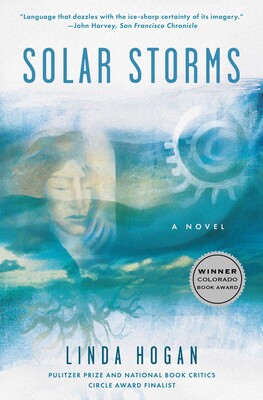
Linda Hogan’s Solar Storms is a 1995 novel that somehow escaped my notice until recently. It brought me to a part of Minnesota I know only tangentially: an isolated Native American settlement on the fringes of the Boundary Waters Canoe Area up north, circa 1971. A troubled teen-age girls returns to her birth family relatives in an attempt to discover the truth of her own violent past–only to step into the middle of the ongoing violence of ‘progress.’ Set at the dawn of the American Indian Movement, the story foreshadows the Standing Rock protests of recent years and takes its readers on an imaginary journey through an alternative mode of living with the world around us.

John Reimringer’s Vestments feels like the work of a present-day heir to the fiction of J.F. Powers and Jon Hassler. The hero is a disgraced young priest whose difficulties adhering to the vow of celibacy force him out of the pulpit and back into the too-tight embrace of his own troubled family in St. Paul. At one point in the story, the hero lives approximate two blocks from the house on Hague Avenue where I grew up: he visits the bars and restaurants I knew as a young adult, encounters the same folks in them that I did back in the day. Reading fiction set in the Twin Cities, I often find myself alienated when the author gets a detail wrong (I’m looking at you, Jonathan Franzen), but to my eyes Reimringer gets everything right.
Speaking of Jon Hassler, I recently with reluctance allowed myself to read The New Woman, the last work in his Staggerford series that my father introduced me to circa 1988. I’ve been savoring the novels over the decades but at last reached the end of the line. I discovered recently, however, that Hassler also put out collections of short stories and essays, as well. I started with his out-of-print 2001 collection, Good People…from an Author’s Life: I bought the Cobb County Public Library’s old de-accessioned copy from an online dealer. As Hassler admits in his preface, it’s tough to write an interesting book about goodness–in terms of thematic interest, it literally pales next to evil. But it’s also a mellow pleasure to read his anecdotes about the people he lived among who became models for the denizens of fictional Staggerford, Minnesota.
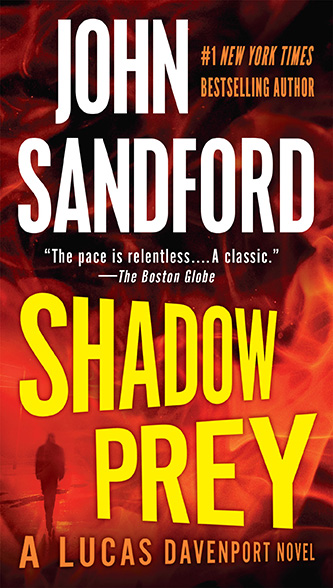
A friend recommended John Sandford’s 1990 thriller, Shadow Prey. I rarely read murder mysteries, but this one is set in the Twin Cities: a serial killer is on the prowl among the local Native American community. The book is in some ways the antithesis of Hogan’s novel: a white male cop plumbs the threatening other-world of indigenous culture. But it again gets the local details of the paranoid world of its protagonist right: reading it, I knew which diner the hero was visiting, which streets housed the villains’ hideout.
Plague Year Listening: A Look Back
The lockdowns of 2020 provided ample opportunities to sit at home and listen to music. Here are twenty albums from the plague year that gave me the most pleasure, listed in alphabetical order.
I got back into the habit of buying CDs this year, so thanks to the pandemic I own physical copies of most of these titles. Looking over the list, I’m pleasantly surprised to see how much of it (seven out of twenty) comes from local Chicago artists. Maybe in 2021 I’ll be able to go see them play live….
Fiona Apple, “Fetch the Bolt Cutters”
Beach Bunny, “Honeymoon”
Curtiss A, “Jerks of Fate”
Ehara Mei ????, “Ampersands”
The Flat Five, “Another World”
Ted Hearne, “Place”
Jyoti (Georgia Anne Muldrow), “Momma, You Can Bet!”
Kate NV, “Room for the Moon”
Lianne La Havas, “Lianne La Havas”
Mary Lane, “The Real Mary Lane”
V.V. Lightbody, “Make a Shrine or Burn It”
Paul McCartney, “McCartney III”
Sen Morimoto, “Sen Morimoto”
Ohmme, “Fantasize Your Ghost”
Kate Rusby, “Hand Me Down”
Tokyo Incidents, ?????? “News” ????????
Twin Peaks, “Side A”
Various artists, “Save Stereogum: An ’00s Covers Comp”
Wussy, “Ghosts”
Zombie-Chang, “Take Me Away from Tokyo”
Open-Access Article: “Early Freeze Warning: The Politics and Literature Debate as Cold War Culture”

An essay of mine originally published in the volume Literature Among the Ruins, 1945-1955: Postwar Japanese Literary Criticism (Lexington Books, 2018) is now available in open-access online form at Asia Pacific Journal: Japan Focus.
Here’s the abstract:
Abstract: This essay revisits the 1946-7 “Politics and Literature Debate??? (Seiji to bungaku rons??), a pivotal controversy among leftist Japanese writers and intellectuals that is conventionally cited as the starting point of postwar literary history. Situating the debate in tandem with three influential texts published at roughly the same time in the West—Lionel Trilling’s The Liberal Imagination (1951), Ruth Benedict’s The Chrysanthemum and the Sword (1946), and The God That Failed (1950), edited by Richard Crossman—the essay argues that the debate should be considered an early instance of the Cold War culture that would emerge globally in the decades that followed.
Also available from Lexington Books is a companion volume, The Politics and Literature Debate in Postwar Japanese Literary Criticism, 1945-52, an anthology of annotated translations of all the key essays from the celebrated “Politics and Literature Debate” in late 1940s Japan.

Free Open-Access E-Book Editions of Two Edited Volumes
I’m delighted that University of Michigan Press has just made two books I edited available in free open-access e-book editions. This was made possible by grants from the National Endowment for the Humanities and the Andrew W. Mellon Foundation Humanities Open Book Program.

The first one is the English translation of Kamei’s Hideo‘s Transformations of Sensibility: The Phenomenology of Meiji Literature(??????????????????). The work was first serialized in Gunzo in 1978-9, then published in book form in 1983, and our translation first came out in 2002. The English translation includes new introductions by Kamei and me, situating the unique approach he takes to literary analysis in the book against its historical situation. You can download the open-access e-book version here.

The second one is The Linguistic Turn in Contemporary Japanese Literary Studies, which first appeared in 2010. It includes translations of classic essays by Kamei, Mitani Kuniaki, Noguchi Takehiko, and Hirata Yumi, plus new scholarly essays by Joseph Essertier, KONO Kensuke, Norma Field, Richi Sakakibara, John Whitman, Leslie Winston, and Guohe Zheng. In my introduction to the volume, I sketch in the history of linguistics-based approaches in Japanese literary scholarship, using the 1980s “Kokoro ronso” as an entryway. You can download the open-access e-book version here.
Re-Encountering John Lee Hooker

Last week, I enjoyed reading Robert Christgau’s belated review of Boogie Man: The Adventures of John Lee Hooker in the American Twentieth Century, Charles Shaar Murray’s 2002 biography of John Lee Hooker, the great Detroit blues musician. Christgau admits that he’s never been a huge fan of Hooker’s recordings, but Murray’s writings have opened his ears in a new way.
No surprise, then, that Hooker has risen in my personal blues pantheon. Sure I still prefer early Skip James and Robert Palmer’s Elmore James best-of, among others. But on The Healer, just as a for instance, I can now hear how right it is that the star-stoked first half, most strikingly the Carlos Santana title song and Los Lobos’s big-bandish “Sally Mae,??? wind down into a guitar-bass-drums “My Dream??? that’s less sung than sweetly murmured and the solo “No Substitute??? finale, which fades into a whisper on the repeated theme “There ain’t no substitute for love.??? “No Substitute??? is some kind of masterpiece. I can’t imagine anyone but John Lee Hooker getting away with it. And I also can’t imagine feeling it the way it deserves if Charles Shaar Murray hadn’t shown me the way.
I haven’t read the Murray book yet, but Christgau has convinced me to put it on my to-read list. And it reminded me of the two times I got to see Hooker play.
The first time was in 1980, I think, at the Union Bar, a venerable blues joint in Minneapolis. I was nineteen at the time and went with my friend Frank to see the “King of the Boogie” in person. We worked our way through the crowd up to the front of the stage, and I remember being blown away by Hooker’s solos. Atonal and punk-ish, they repeatedly seemed on the verge of veering off into chaos but then Hooker would play a lick that instantly pulled the whole string of notes together so that the whole thing made brilliant, completely unexpected sense. It was as if the rest of us were stuck in Euclidean geometry, and he was playing fractal equations. Hooker was sixty-three at the time, but his calloused and deeply grooved fingers looked like they were about a thousand years old.
All through the show, two women who looked to be in their late twenties were standing right in front of Hooker, who played sitting in a chair. I noticed that one of the women kept reaching out and stroking Hooker’s shin as he played. He steadfastly ignored this for most of the set, until near the end of the evening. At that point, he looked straight at the woman with a grin on his face and announced, “The next song goes out to a young lady in the audience tonight. It’s called, ‘(If I Could Only Do Now) The Things That I Used to Do.”

The second time was in the summer of 1986. He was playing at the Cabooze near the University of Minnesota campus. I went with my friend Tom. Again, Hooker provided an amazing lesson in how to make the blues sound completely original. Between sets, they announced that he would be available at the merchandise table to sign autographs. So Tom and I dutifully lined up: for a mere $5, you could get your own signed John Lee Hooker photograph.
As we waited, though, I saw that the whole process was oddly mechanical. When your turn came, you approached Hooker, who took the 8×10 glossy from his manager and slowly printed his name below at the bottom with a thick magic marker. He barely made eye contact with the fans who had waited their turn.
This wouldn’t do. So, when my turn finally came up, I lied through my teeth. “Great show,” I said. “You know, the last time I saw you play was two years ago, in Sendai, Japan.” Hooker’s show in Sendai happened in early 1984, before I got there for my year-abroad program that autumn, but I heard all about it from friends at the Peter Pan rock music coffee house. Hooker paused, looked up at me with a smile and asked how long I had stayed in Sendai. I told him I’d stayed there for a year and that I was looking for a way to get back–both of which were true. He asked if I had a girlfriend there, and I told him that I did. He smiled again and said something about how much he liked touring in Japan. He then took up the black marker and signed my photograph (that’s it above) and it was Tom’s turn to get his autograph.
Honesty is usually the best policy, but not always.
A Light Bulb Goes On in my Mind

I am reading Mark Fisher’s brilliant posthumous collection, K-Pop: The Collected and Unpublished Writings of Mark Fisher (2004-2016) (edited by Darren Ambrose, Repeater Books, 2018) and come across the following passage from his 2004 essay, “K-Punk, or the Glampunk Art Pop Discontinuum.” In the piece, Fisher is trying to define the position of glam rock (in particular, Bryan Ferry and Roxy Music) in a history of UK youth subcultures.
Here’s the passage that caught me up (p. 279):
After the Fifties, pop and art have always been reversible and reciprocally implicating in British culture in the way that they are not in America. […] British pop’s irreducible artificiality makes it resistant to the Romanticist naturalisation that the likes of Greil Marcus and Lester Bangs achieved in respect of American rock. There’s no way of grounding British art pop in a landscape.
Not a natural landscape in any case. […] in the late-twentieth century the ‘space’ of the internal-psychological was completely penetrated by what [J.G.] Ballard calls the media landscape.
When the British pop star sings, it is not ‘the land’ which speaks (and what does Marcus hear in the American rock he mythologises in Mystery Train if not the American land?) but the deterritority of American-originated consumer culture.
Fisher is guilty of a bit of over-generalization here, of course, but he’s also onto something. And the light bulb goes on in my head:
“We are the Village Green Preservation Society, God save Donald Duck, vaudeville, and variety” (“Village Green Preservation Society,” The Kinks, 1968)
“We’ll surf, like they do in the U.S.A.” (“Australia,” The Kinks, 1969)
“Cos I’m a Muswell Hillbilly boy/But my heart lies in old West Virginia/Never seen New Orleans, Oklahoma, Tennessee/Still I dream of the Black Hills that I ain’t never seen” (“Muswell Hillbilly,” The Kinks, 1971)
“Everything around me seems unreal/Everywhere I go it looks and feels like America” (“Working Man’s Cafe,” Ray Davies, 2007).
Of course, Ray Davies had this realization long before I did.
Americana. It started as a flickering light sending black-and-white images through an old movie projector. Faces of cowboys and Indians, superheros, the good guys victorious over the emissaries of evil. Then as I grew the music took over. Rock, jazz, skiffle…the blues…and country songs came to liberate me, a north Londoner, growing in [sic] up in the austerity of postwar Britain. The music gave me hope and feeling that I could express myself in song through this new art form called rock and roll.
(Ray Davies, Americana: The Kinks, the Road, the Story [Sterling, 2013], p. viii)

