

Songs in High Rotation Just Now
“Little Bird” by Eels (from their new CD, End Times) is one of the better break-up songs I’ve encountered lately.
I have tickets to see the one and only Ray Davies here in Chicago on Saturday night. Here’s one of the back-catalog songs he’s resuscitated for the current tour:
And here’s Delroy Wilson’s 1968 cover of the obscure Motown song, “Put Yourself in My Place” (apologies for the abrupt cut off at the end):
Ah, the sadness of pop songs. As Nick Hornby sums it up so admirably in High Fidelity, “Which came first, the music or the misery? Did I listen to music because I was miserable? Or was I miserable because I listened to music? Do all those records turn you into a melancholy person?” Hell if I know, but Mr. Bartender can I please have change for this fiver so I can plug another handful of quarters into the jukebox?

I’m back!
Apologies for the radio silence around here lately. It’s been a wee bit busy on the South Side the past week or two. I’ll resume real blogging in short order, but in the meanwhile, here’s a clip I posted here a zillion years ago that’s well worth revisiting. It’s Kate Rusby’s cover of one of the very greatest of Kinks’ songs, “Village Green Preservation Society.” Nice slide show to go with it, too.
We are the Office Block Persecution Affinity
God save little shops, china cups and virginity
We are the Skyscraper condemnation Affiliate
God save tudor houses, antique tables and billiards
Preserving the old ways from being abused
Protecting the new ways for me and for you
What more can we do?
God save the Village Green
Getting the Band Back Together
Everyone is doing it these days, it seems. Yoko Ono has reunited the Plastic Ono Band. Minnesota punk-funk-rock legends The Suburbs got back together last weekend for a show in honor of their guitarist, Bruce Allen, who passed away late last year. Stew and Heidi, late of The Negro Problem and the musical Passing Strange, have a new show up this week that’s all about breaking up. Anzen Chitai, the kings of 1980s Japanese soft-rock, have likewise announced an upcoming reunion tour.
Everybody’s doing it, it seems….except of course for The Kinks. But at least now we have a new documentary feature film that explains, after a fashion, why that isn’t happening. Do It Again: One Man’s Quest to Reunite the Kinks had its world premiere last month at the International Film Festival Rotterdam. Directed by Robert Patton-Spruill, the film follows the quixotic journey of Boston reporter Geoff Edgers, who is determined to bring Ray, Dave, Pete and Mick back together again. I haven’t seen it yet, but the film has been getting good reviews (e.g. here and here) and will be playing at a series of film festivals in the coming months (details available on the film’s website).
Scary Disney Rides
It must have been 1998 or thereabouts. Walter was 7 and Sonia was 2, and we were living in Los Angeles. One winter Sunday morning, we got up early and drove down to Anaheim, timing it so we arrived at Disneyland just as the park opened. The thought, of course, was to beat the crowds.
We rush in through the entrance gate and there is no one, I mean NO ONE, there. I tell the kids, quick, let’s jump onto as many rides we can before the long waiting lines form. I don’t care what rides: just anything, while there is no waiting. Without thinking, we rush into the Peter Pan attraction. It isn’t a good choice: we end up riding through the dark with mechanical pirates popping up and threatening to attack us. Sonia breaks down into hysterical wailing. Even big brother Walter is a little shaken up. Who would have thought a Peter Pan ride could be so intense?
After that, Sonia is leery of any rides. It takes a good deal of coaxing and persuading, but we get her to ride the spinning teacups, the flying Dumbos, and one or two others. And then I think: “It’s A Small World.” What could be safer?
By now the park is pretty crowded. We have to stand in line at “It’s A Small World” for maybe twenty, thirty minutes. All the while, I’m telling Sonia how much she’s going to like this one. Finally, we get into the little boat. We start moving forward through the channel, slow and gentle. Everything’s fine. But then we enter into a dark room. Sonia tenses up. Next we turn the corner and are suddenly surrounded on all sides by hundreds of little horrific dolls, all singing in diabolic voices, “It’s a small word after all…,” all of them swiveling in this robotic jerky back-and-forth movement. Sonia screams in terror for the rest of the ride, completely inconsolable.
I’ve learned this week that Sonia isn’t the only one to get freaked out about “It’s A Small World.” Greg Kot in the Chicago Tribune interviewed rising UK singer Ebony Bones this week. He asks about her striking look, and she describes her style as being like “a dark Disney ride.” Kot pursues this issue further:
Did she ever experience a dark Disney ride?
“Absolutely! My parents took me when I was 9 and it was vile. I hated it. The ‘It’s a Small World’ ride terrified me: All these kids from strange countries staring at me. I wanted to jump off the ride.???
I don’t know if St. Vincent had any bad Disney experiences while growing up. She seems pretty well adjusted. Anyhow, I really like what she does to the Beatles’ “Dig a Pony.”
Why I’ll Never be a Pop Star in China: Reason #58
According to the BBC, they fine you there if you lip-synch in concert. Besides, according to the article, you need a license to be a pop singer in China. It’s hopeless for me.
Passing Strange: The Movie
I’ve been a big fan of musician Stew for more than a decade, since I first stumbled across his band The Negro Problem back in the late 1990s. He takes the sound of 1960s sophisticated California pop (think Arthur Lee and Love or Jimmy Webb) and updates it with lyrics that shimmer with wit, intelligence, and poetry. Throw in a remarkable gift for composing haunting melodies and you have a singer-songwriter who I think is a living national treasure. The best gift I ever gave Satoko was for Valentine’s Day 2006, when I was able to get Stew to record a personalized song for her commemorating the holiday. Satoko said it almost made up for all the other crummy presents I’d given her over the years.
So I was delighted when Stew’s musical, Passing Strange, won him some much deserved attention, including a Tony Award for its 2008 Broadway engagement. I thought about flying out to New York to see the show during its two runs there, but never made it. I did snap up the original cast recording CD when it was issued and fell in love with many of the songs on it.
In the end, though, I never saw the show live. Last night, I got to see Spike Lee’s film version, which records the final Broadway performance at the Belasco Theater. I was prepared to like this film, needless to say. But I wasn’t fully prepared for how powerful the experience was. It had me in tears more than once–that is, when I wasn’t laughing or tapping my foot in time to the music.
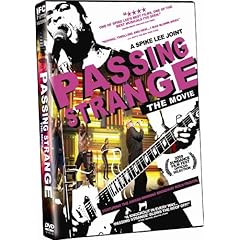
It’s a Portrait-of-the-Artist-as-a-Young-Man narrative combined with an electrifying rock show: Stew, his longtime collaborator Heidi Rodewald, and band are on stage the whole time, frequently interacting with the actors. The cast is astonishingly good. Many of the players take up multiple roles during the course of the evening, and it is sheer pleasure to watch them inhabit the bodies of radically different sorts of characters. Through it all, Stew serves as the avuncular narrator, stepping up to centerstage whenever the need arises for a rock-and-roll explosion. Spike Lee’s direction is lean but creative: he even gets a cast member to carry a video camera on stage to film one sequence (watch the Special Features section on the DVD for more about this).
I can only guess how much more powerful the show must have been live. It’s difficult to imagine another cast ever taking it on, so probably this filmed version is the best I’ll get. I hate to set you up with excessive expectations that no movie could ever satisfy; undoubtedly, the best way to encounter this would be to stumble across it unexpectedly and be blown away. But I’d hate for anyone to miss this one: do yourself a favor and watch the thing. It’s a work of art, and to paraphrase Stew, life is full of mistakes, but art is where we go to correct them.
A Ray of Hope
The gloom of winter: this morning, the radio newscaster announced that the wind chill factor outside was “4 below” and then, not five minutes later, amended that to “6 below.” Yikes. But things got a little more warm and cheery in Chicago yesterday, because we learned that Ray Davies is on his way: a new March U.S. tour was announced. It includes a March 13 gig here at the Riviera. The full tour schedule is available here.
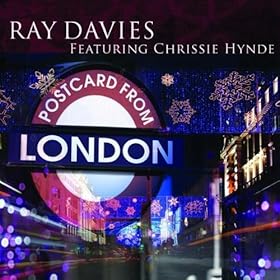
On top of that, “Postcard from London,” Ray’s new duet with Chrissie Hynde, was officially released in the U.S. yesterday. You can download it at Amazon.com or at I-Tunes.
So I’m in a pretty good state of mind. And I’ve shut the radio off, because I don’t want to hear what the newscaster will say next.
Symphony, Sumo, Symphony
The weekend began Friday afternoon at Symphony Center for a matinee performance, Pierre Boulez leading the Chicago Symphony as part of the celebrations for his 85th birthday. I’d never seen the great man conduct before and was struck with his economy of motion: no over-emoting for him. Whatever the style, it worked: the orchestra played as well as I have heard it. The program opened with the latest incarnation of Boulez’ own Livre pour cordes, a particularly warm instance of serialism. They moved on from there to take on the tricky twists and turns of Bartok’s Concerto for Two Pianos, Percussion and Orchestra, played brilliantly by Pierre-Laurent Aimard and Tamara Stefanovich as the keyboard soloists. It’s a work in which Bartok explores the percussive nature of the piano, setting the keyboards in complex dialogues with drums, xylophones, and other struck instruments. The program closed with a thrilling rendition of Stravinsky’s The Firebird played in the full ballet version. John von Rhein, the Chicago Tribune’s classical music critic, was similarly enthusiastic in his review of the Thursday evening performance.
In the meanwhile, on the other side of the world, yokozuna Asashoryu, the bad boy from Mongolia, took charge of the New Year Sumo tournament. He wrapped up the title on Day 14. It was his 25th career championship, putting him in third place in the record book. The victory came in the final tournament for Uchidate Makiko, Asashoryu’s long-time nemesis on the Yokozuna Deliberation Council, making it all the more satisfying. Moreover, Asashoryu gave us yet another spectacular example of his trademark misbehavior during the tournament, coming close to getting himself arrested in a drunken brawl late at night after Day 6. The tournament, as expected, also saw the retirement of the great ozeki Chiyotaikai. Yokozuna Hakuho managed to defeat Asashoryu in their direct meeting on the final day, but that victory was purely moral, as Asashoryu was simply killing time until the trophy ceremony.
Friday night ended with another classical concert: Europa Galante led by violinist Fabio Biondi at Mandel Hall. A period instruments ensemble, they opened with two lovely pieces by Telemann. Guest flutist Frank Theuns could easily be the model for a new muppet character. They closed with an edgy version of Vivaldi’s The Four Seasons, the schmaltz factor reduced to almost zero, reminding us in the process that a terrific piece of music lies buried beneath all the abuse that mass culture has heaped on to it. Two short encore pieces by Corelli and Gluck (the latter had the violinists plucking their way through) brought the evening to an airy close. The Chicago Classical Review website liked the performance, as the did the critic for the New York Times, who caught much of the same program last week at Carnegie Hall (where, no doubt, the acoustics were better….).
This and That
The New Year sumo tournament is heading into its final days now with yokozuna Asashoryu holding the lead at 11-1 and fellow yokozuna Hakuho lingering one step behind at 10-2. Hakuho just lost today to ozeki Harumafuji, but perhaps the most exciting match so far was yesterday’s face off between Asashoryu and sekiwake Baruto. See if you can tell who won from this photograph (link courtesy of Moti’s sumo news mailing list). Meanwhile, the sport’s backstage politics have hit the front pages, as former yokozuna Takanohana pursues his reform effort by seeking a spot on the Sumo Association’s board of directors.
Meanwhile, in another fine old Japanese cultural institution, the Emperor’s New Year waka poem for 2010 (source):
Where rays of sunlight
Filter through the trees I see
In the middle of the path
Carpeted with fallen leaves
A clump of green grass growing.
The assigned theme this year was “light.” Back in the old days, this would have been by definition the best poem of the year.
Although I have my doubts about the accuracy of the crowd count figure given, this article shows that legendary J-Rock band X-Japan can still pack them in, even in Los Angeles. Meanwhile, the Tokyo Shinbun newspaper is reporting (Japanese-language only) on the hit chart bounce enjoyed by artists featured on the NHK Kohakau Utagassen New Year’s Eve television spectacular. Ikimono Gakari’s “YELL/Joyful” (performed to great effect in the NHK broadcast with the backing of a choir of junior high school students) jumped from #23 to #12 on the Oricon charts the week after the show, while Kimura Kaera’s “Butterfly” moved up from the teens to the #1 slot on several music download sites, including I-Tunes Japan.
This has nothing to do with any of the above, but recently while wading through the Internet, I came across some amazing live performance of Iggy & The Stooges from 1970. Let’s call it “The Sweet Bloom of Youth.” Subtitle: “A Boy and his Peanut Butter.”
Asakawa Maki (1942-2010)
The Yomiuri newspaper is reporting (Japanese-language only) that legendary singer Asakawa Maki was found dead Sunday in a Nagoya hotel. She was 67 years old. A legendary, charismatic figure, she was the late 1960s “Queen of Underground Music.” Asakawa began appearing in Terayama Shuji’s experimental theatrical productions in 1968 and quickly became an icon of New Left culture. She released her debut album in 1970, featuring a melancholic singing style that combined jazz, blues, and chanson. Her persona coupled a cool, mysterious sexiness with searing intelligence. Asakawa always dressed in black and was usually surrounded by a haze of cigarette smoke (or at least, that was the image). She continued to perform and record regularly over the decades and was in Nagoya this weekend for live appearances at a jazz club there.
R.I.P.

