

Inoue Hisashi and the Shifting of the Tides
Greetings from Tokyo, where I arrived Friday for a short research trip. A few cherry blossoms hung on long enough for me to be able to enjoy them, though they are now fast disappearing from the landscape.
The newspapers here are reporting the death of the great novelist and playwright Inoue Hisashi. He was 75 and had been battling cancer for some time. Raised in an orphanage in Sendai, Inoue first attracted attention in the early 1970s with his brilliant, often funny and often sharply critical, fiction. He liked to employ nonstandard forms of writing: he invented, for example, a fictional language for his 1981 masterpiece Kirikirijin. From the 1980s his focus shifted to writing primarily for the stage. Just last year he staged a successful dramatization of the life and work of proletarian literature writer Kobayashi Takiji.
Inoue was also a prominent public intellectual. He lent his voice and pen to a number of worthy causes–most notably the efforts to save Article 9, the no-war clause of the Japanese constitution. On that note, the Yomiuri newspaper is by coincidence also reporting on one of Inoue’s most important legacies. Given the newspaper’s strong bias toward changing Article 9, its coverage of the issue has to be taken with a grain or two of salt. But today’s Daily Yomiuri describes what seems to be a significant change over the past year in Japanese public opinion on the issue:
Thirty-two percent of people surveyed felt Article 9–the constitutional clause renouncing the right to wage war–should be amended as it hampers the country’s ability to deal with related issues because of how the article is interpreted. This number, too, was lower than 38 percent in last year’s survey.
Meanwhile, 44 percent of respondents said related issues–such as the dispatch of Self-Defense Forces on international peacekeeping operations–should be dealt with through the conventional interpretation of Article 9. In the previous survey, 33 percent felt this way.
The big story, in other words, is a large shift in public sentiment toward keeping Article 9 in its present form. Last year 52% supported and 36% opposed constitutional revision, while this year the figures were 43% and 42% respectively. Of course, the headline to the Daily Yomiuri story chooses a different angle: “Poll: Public split over amending Constitution / Over 70% think govt should discuss issue.” (The headline on the original Japanese-language version of the article does a better job of conveying the story, I think).
Of the nine prominent intellectuals who in 2004 launched the citizens’ movement to save Article 9, only six are still with us today. But as the story above shows, their efforts are bearing fruit. I’ll resist the temptation here to use the cherry blossom metaphor, although it seems quite apt.
In his lecture at the University of Chicago last month, Oe Kenzaburo noted that there are now more than 700 local chapters affiliated with the movement across Japan. To paraphrase another playwright, the good Inoue Hisashi did lives on after him. Rest in peace.

This and That: Science and Technology Edition
We enjoyed a quiet Easter. I managed to get to church — but cheated, in that my “worship service” consisted of the Art Hoyle Quintet performance at Hyde Park Union Church, sponsored by the always wonderful Jazz Sundays series organized by the Hyde Park Jazz Society.
Some interesting science and technology news that’s caught my eye lately:
The lunatic notion that genetic codes found in nature can be patented is finally facing skeptical court scrutiny, the New York Times reported last week. For the sake of culture and scholarship, we really need to curb the voracious appetite for infinitely expanding intellectual property claims, and this seems a modest step in the right direction.
Are the problems faced by scientists trying to gear up the Large Haldron Collider actually the work of a Terminator sent from the future in a desperate attempt to head off an unwelcome scientific development? The possibility has been suggested in a series of recent scientific papers, Time magazine reports.
Finally, a whole slew of new technological devices and digital scientific analytical techniques are being applied to baseball. The conclusion from statistical crunching of multi-angle digitized tracking of pitches over the course of an entire season? That good pitchers paint the corners, while bad ones hang it over the plate. Now they’re turning their attention to batters and defenders and will not doubt reach many revolutionary hypotheses, such as declaring that batters should try to hit the ball with the sweet spot of the bat and that fielders should try to catch the ball with both hands. Ah, the marvels of science.
In the meanwhile, play ball! The Twins kick off their season tonight in Anaheim.
On the Road Again
Good morning from Philadelphia, where I arrived late last night to attend the Association for Asian Studies Annual Meeting. I perhaps should say that I’ve “returned” to Philadelphia, since I was here on Monday and Tuesday for the NCC-3D conference, a large gathering of librarians, scholars and others who are concerned with the state of Japanese library resources in North America. As always happens when I get together with librarians and other information science people, I was impressed with the knowledge, passion, and commitment they bring to their professions. It was also exciting to learn about new developments in the field–the progress, for example, of the digitization project at Japan’s National Diet Library.
The other thing that became clear to me at the event, as it has at every recent scholarly event I’ve been to, is how much pressure everyone is facing in this time of slashed budgets, rising costs, and uncertainty about the future. These are challenging times for people who care about scholarship in North America–and in East Asia, too.
Yesterday, I was up at Princeton participating in the Workshop on Postwar Literary Criticism, the initial event in an exciting new collaborative research project that brings together faculty and students from the University of Chicago, Princeton University, and Waseda University. On the morning panel, Toeda Hirokazu (Waseda) presented some very intriguing ideas about how we should bring in the issue of censorship when we rethink literary criticism from early postwar Japan. He’s one of the editors of a new series of books that collects Occupation-period censorship records, and in his talk he showed us some remarkable instances of the conditions under which Japanese writers and editors functioned in the late 1940s.
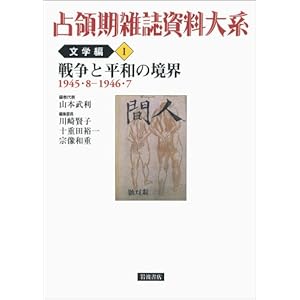
Sakakibara Richi (Waseda) spoke on the 1946-7 “Politics and Literature” debate among leftist and Marxist critics, noting the implicit rise through the course of the debate of a series of shared concepts and keywords among participants who seemingly agreed about nothing. She also traced through how those same concepts and keywords meant something very different for the participants in the debate from what they mean today. I spoke about the same “Politics and Literature” debate as an early instance of Cold War culture, situating the works of such Japanese critics as Hirano Ken, Ara Masahito, and Nakano Shigeharu alongside that of some of their contemporaries in North America. In the afternoon, we had some excellent suggestions for the papers and projects from two discussants, Victor Koschmann (Cornell) and Richard Calichman (City University of New York). Then we had another terrific session in which graduate students from the three schools presented their thoughts about how to translate and annotate texts from early postwar literary criticism in ways that will address a variety of different kinds of readers.
The joint research project is off to an exciting start. We’ll bring the group together again for another workshop in Tokyo at Waseda this summer and then wrap things up with a formal international conference at Chicago next year. It’s the sort of project that makes you feel hopeful for the future, despite all the bad news about budgets that plague academic life in both Japan and North America these days.
The agenda for today is to carry out some sightseeing in Philadelphia with my daughter and to catch a panel at AAS tonight. Tomorrow morning I’ll visit another panel or two, visit the publishers’ exhibition hall to say hello to some editors I work with, and we’ll be on a plane back to Chicago tomorrow afternoon.
Finally, say “happy birthday” to one of my childhood heroes. I’m going to have check out that new DVD set….
This and That
The sumo tournament in Osaka has reached the midway point, and as expected sole yokozuna Hakuho (7-0) has dominated. But two promising rikishi have also stepped up to take advantage of the opening created by yokozuna Asashoryu’s sudden retirement last month: ozeki Harumafuji, the former Ama and a disappointment since his promotion to ozeki a couple of years back, is now 7-0, as is sekiwake Baruto, who could win promotion to ozeki with a championship in this tournament. Baruto in particular has been impressive: he just looks much more serious about things this time around, his goofy grin a thing of the past. Down in the maegashira ranks, Tokitenku is also 7-0, but that’s just a bunch of smoke and mirrors.
In the meanwhile, spring has arrived in Chicago (never mind those snowflakes falling outside the window as I write these words). I celebrate by listening to Minnesota Twins spring training games in the afternoon at my office. I’m pretty optimistic about the coming season, despite noises being made by local White Sox fans….
In the category, “It’s bloody well about time”: Universal betting on lower prices to boost CD sales.
Ray Davies continues to wow them on his current tour. MSN.com reports that “Ray Davies rules on second night of SXSW.”
The coming week should be a hectic one for me. I’m in Philadelphia on Monday and Tuesday for the NCC 3D conference, then up to Princeton for the “Rethinking ‘Hihyo’: Postwar Literary Criticism and Beyond” workshop, then back down to Philadelphia on Thursday for the 2010 AAS Annual Meeting.
I leave you with the late Alex Chilton. I saw him play with the reunited Big Star seven or eight years ago at Royce Hall on the UCLA campus. It was a joyous occasion, especially when they covered The Kinks’ “‘Till the End of the Day.” Ray Davies dedicated that song to Chilton in his performance at SXSW this week (where Chilton had been scheduled to play) and spoke from the stage about how Chilton had visited him in the hospital after he was shot in New Orleans. A great songwriter and a wonderful voice: so long, Mr. Chilton.
All I Know is What I Read in the Papers
There was an amusing editorial cartoon in the Chicago Tribune this past weekend by Scott Stantis. A mother sits at the breakfast table, reading the newspaper, and announces to her two children that the Post Office might stop delivering letters on Saturday. Her son, busy at his laptop, asks, “What’s a letter?” Her daughter, texting on her cellphone, tops this by asking, “What’s a newspaper?”
The state of the newspaper industry in Japan isn’t quite so grim as in America, but the numbers are still tumbling. The hard-right Sankei newspaper is taking the biggest hit, report Peter Alford and David McNeill in a very interesting article up this week at The Asia-Pacific Journal: Japan Focus. Daily circulation figures for Japan’s major newspapers still dwarf those in other countries.
Slowly, however, the gravity-defying circulations appear to be heading for earth. ABC statistics on the main morning-edition circulation for 2006 to 2009 show that every Japanese newspaper recorded a loss of sales, except the business-oriented Nikkei. In relative terms, the declines are tiny: the world’s best-selling newspaper, the conservative Yomiuri is down from 10,042,075 to 10,018,117; the liberal-left Asahi from 8,093,885 to 8,031,579; the liberal Mainichi has taken a more substantial hit, from just under 4 million to 3.8 million. The Nikkei is up slightly from 3,034,481 to 3,052,929. Perhaps more indicative, and worrying, for the industry is the sharp drop in advertising revenues: from one trillion yen in 2007 to an estimated 600 billion in 2009, a year in which online advertisements continued to grow.
Those same newspapers are reporting just now (so far Japanese-language only, but I’m sure the English papers will be carrying this in a few hours) that film director Kitano Takeshi has just been awarded France’s highest cultural honor. This all coincides with a film festival and art show in Paris featuring his works.
Why I’ll Never be a Pop Star in China: Reason #58
According to the BBC, they fine you there if you lip-synch in concert. Besides, according to the article, you need a license to be a pop singer in China. It’s hopeless for me.
God Save the (Cultural) Village Green
A few years back, as part of an ongoing project to rethink the works of novelist Natsume Soseki (1867-1916) in relation to the rise of modern regimes of property ownership, I wrote an article on him in relation to Mizuno Rentaro (1868-1949), chief architect of Japanese’s 1899 copyright law, a legal code that remained in effect — albeit with amendments — until 1970.
Under that law Soseki’s copyrights expired in the 1940s and his works entered the public domain. But in 1979, when Readers Digest Japan advertised a new series it was publishing that reproduced first editions of Soseki’s works, it found itself the target of multiple lawsuits filed by various publishing houses and other parties. The plaintiffs claimed that they held intellectual property rights in the physical appearance of those first editions. In essence, a moral right of authorship was being asserted for the acts of typesetting and printing of a book. As a result of out-of-court settlements in the Readers Digest Japan case, a new “right of reproduction” became standard in the Japanese publishing world. In a move the current U.S. Supreme Court would no doubt beam down upon with approval, the locus of the creative, original mental labor that was the original justification for copyright protection was shifted away from the personality of the author and onto the act of investment of the publishing house. Capital was granted the status of moral personality.
In a depressingly similar move, this week the NFL claimed ownership over the “Who Dat?” slogan used by fans of the New Orleans Saints football team. Though the phrase has a long history preceding the 1988 trademark registration filed by the team, the NFL is claiming exclusive authorship privileges and threatening to sue anyone who uses the phrase without permission. The NFL claim rests on very shaky legal ground; in fact, another business registered a trademark on the phrase several years before the Saints did, and the phrase has been in popular circulation for more than a century. But few small businesses or individuals have the financial capacity to engage in a court battle with a huge corporation like the NFL when it mounts this sort of intellectual enclosure.
This sort of situation is increasingly common in trademark law. Trademark originally was supposed to pertain only to specific, denoted meanings of a phrase, but increasingly legal decisions are expanding its domain to include secondary connoted meanings produced in the public commons by anonymous users of the phrase. Hence, McDonalds Corporation, for example, has claimed to own the nickname “Mickey D’s.” As legal scholar Rosemary Coombe notes:
The trademark owner is invested with authorship and paternity; seen to invest ‘sweat of the brow’ to ‘create’ value in a mark, he is then legitimately able to ‘reap what he has sown.’ The imaginations of consumers become the field in which the owner sows his seed—a receptive and nurturing space for parturition—but consumers are not acknowledged as active and generative agents in the procreation of meaning. The generation of new, alternative, or negative connotations are ignored, denied, or prohibited because patrilineal rights of property are recognized as exclusive: no joint custody arrangements will be countenanced.
(Coombe, The Cultural Life of Intellectual Properties: Authorship, Appropriation and the Law. Duke University Press, 1998, p. 71)
The author may be dead in literary studies, as we focus more on the dialogic process by which meaning is produced through the relationships between author, text, and the community of readers. But in trademark law, the High Romantic version of the Author as the seminal source of all Meaning remains alive–or, more accurately, undead, a kind of zombie creature that lives on by sucking the living blood of readers and, now, of football fans.
It’s another instance of what scholars like Kembrew McLeod (the man who trademarked the phrase “Freedom of Expression”) and James Boyle have attacked as the contemporary equivalent to the enclosure of public commons land during early capitalism. It’s depressing to watch Japan in recent years follow the lead of the U.S. (which in turn is following the lead primarily of the motion picture and television industry) and propose extending the length of copyright protection to seventy years. I’m not opposed to copyright per se, but we are seeing an alarming destruction of the public domain, assaults on the notion of fair use, and a general attempt to transform into private capital the cultural and intellectual discourse that by its nature must be shared in common.
This and That
The New Year sumo tournament is heading into its final days now with yokozuna Asashoryu holding the lead at 11-1 and fellow yokozuna Hakuho lingering one step behind at 10-2. Hakuho just lost today to ozeki Harumafuji, but perhaps the most exciting match so far was yesterday’s face off between Asashoryu and sekiwake Baruto. See if you can tell who won from this photograph (link courtesy of Moti’s sumo news mailing list). Meanwhile, the sport’s backstage politics have hit the front pages, as former yokozuna Takanohana pursues his reform effort by seeking a spot on the Sumo Association’s board of directors.
Meanwhile, in another fine old Japanese cultural institution, the Emperor’s New Year waka poem for 2010 (source):
Where rays of sunlight
Filter through the trees I see
In the middle of the path
Carpeted with fallen leaves
A clump of green grass growing.
The assigned theme this year was “light.” Back in the old days, this would have been by definition the best poem of the year.
Although I have my doubts about the accuracy of the crowd count figure given, this article shows that legendary J-Rock band X-Japan can still pack them in, even in Los Angeles. Meanwhile, the Tokyo Shinbun newspaper is reporting (Japanese-language only) on the hit chart bounce enjoyed by artists featured on the NHK Kohakau Utagassen New Year’s Eve television spectacular. Ikimono Gakari’s “YELL/Joyful” (performed to great effect in the NHK broadcast with the backing of a choir of junior high school students) jumped from #23 to #12 on the Oricon charts the week after the show, while Kimura Kaera’s “Butterfly” moved up from the teens to the #1 slot on several music download sites, including I-Tunes Japan.
This has nothing to do with any of the above, but recently while wading through the Internet, I came across some amazing live performance of Iggy & The Stooges from 1970. Let’s call it “The Sweet Bloom of Youth.” Subtitle: “A Boy and his Peanut Butter.”
Structural Changes in the Japanese Economy
The last two decades have seen dizzying changes in Japanese society and culture. The truisms that I was taught about Japan in the 1970s and 80s largely no longer hold in the wake of the economic dislocation and the neo-liberal government responses to them that have taken hold since about 1991. The lifetime employment system is now largely a thing of the past, the celebrated education system has broken down, and it is no longer true that everyone in Japan considers themselves middle class. New lifestyles and new cultural forms have emerged in response to these changed circumstances, and the changes in the way people imagine their community are palpable to anyone who has spent time there.
Yesterday, my colleague Norma Field gave an interesting talk here on “From Literature to Labor in Contemporary Japan and Other Nonprofessional Reflections.??? She connected her own scholarly work on proletarian literature author Kobayashi Takiji (1903-33) and the recent boom in interest in his writings in Japan with the drastic alterations in Japanese labor conditions, as well as with recent work by activists trying to respond creatively and effectively to the new harsher conditions. She also reflected on her own efforts to relate academic work to political activism.
These questions are being addressed by a variety of scholars from a variety of positions. Last September at the British Association of Japanese Studies annual meeting, University of Tokyo economist Genda Yuji gave an interesting talk on “Japanese Youth, Employment, and Hope.” While I had some qualms about the prescriptions for action that he proposed, Professor Genda pointed out some interesting structural factors in the economic changes Japan has faced. I’m doing this from memory and may have some of the facts off, but as I recall, he argued that the origins of the structural changes should be located not in the bubble burst of 1991, but rather in the decade before. Already by 1984, the single-person household had become the dominant domestic form in Japan, meaning that older familial support networks had largely disappeared by that time. Moreover, he argued, at around the same time the non-elite track for achieving economic security had disappeared: previously, large numbers of students dropped out of formal education after middle school and pursued apprenticeship-like positions in their late teens before moving on to establish their own independent small businesses in their twenties, but by the mid 1980s that pattern had entered into a decisive decline. Instead, such persons are now likely to end up in the precarious situation of being “freeters.”
Radical restructuring of the education system in Japan is both a cause and a result of these economic and cultural changes. Anthropologist David H. Slater has a fascinating article this week at The Asia-Pacific Journal: Japan Focus on “The Making of Japan’s New Working Class: “Freeters??? and the Progression From Middle School to the Labor Market.” He explores how students in the lower rungs of the educational system get trapped into work roles that provide no security and little future. He also explicates the mechanisms that hinder the rise of a new sense of class identity among these workers.
In Japan, the educational system has probably been the primary institution most responsible for both of these functions. That is, schooling is the primary site for the development of shared patterns of representation and whole-culture forms so central to the integrity of adult culture and social cohesion, and at the same time, it is the primary mechanism for the social and cultural differentiation of different segments of the population into distinct class trajectories which is central to the reallocation of young people into a highly diversified labor market.
Change is bad: it’s one of the governing motifs of this blog. The last two decades of life in Japan provide a prime example. Structural changes also, however, create opportunities for creating new forms of community and new networks of mutual support (this was one of the main points of Professor Field’s talk yesterday). In other words, the process of change hasn’t yet reached any stopping point. I’m hardly the only one who feels simultaneously pessimistic and optimistic about the future in Japan–and elsewhere.
How I Spent My Winter Break

504 pieces in all, it took Sonia and me four days to complete. I love doing jigsaw puzzles over the holidays: it gives me this luxurious feeling of burning time, like a millionaire torching twenty-dollar bills to light his cigars.
But do I really have to go back to work tomorrow? I love teaching, but would another week of winter break really cripple the university? My biggest complaint about the quarter system (as opposed to the morally superior semester system) is the short winter break. Sigh.
In the meanwhile, the NY Times reports that even old decrepit types like myself can learn new tricks, if we approach our neurons and synapses from the proper angle. “Disorienting dilemma” is the trick, they tell us. That should be a snap, since I spend most of my time in that state these days anyhow.
Anime god Miyazaki Hayao has granted a rare interview, prior to the opening of his latest work, Ponyo, in the UK next month.
Finally, a ray of hope from Kichijoji, one of my favorite neighborhoods in Tokyo: a new campaign to save the neighborhood sento (public bath) by way of rock music. It’s got a back beat, you can’t lose it, and you can get your back scrubbed at the same time. Brilliant!


