

A Novelist Re-Reads Kaitokudo
I had the honor and pleasure yesterday of introducing and serving as interpreter for Oe Kenzaburo, 1994 Nobel Laureate in Literature, in this year’s installment of the Tetsuo Najita Distinguished Lecture series here at the University of Chicago. Professor Najita was in attendance, too, and it turned into a very moving tribute from one old friend to another.
Oe took up Najita’s landmark study, Visions of Virtue in Tokugawa Japan: The Kaitokudo Merchant Academy of Osaka, and traced its impact on his own life and writing. It turns out that Oe’s own Great Grandfather studied at a merchant academy much like the Kaitokudo in nineteenth century Osaka, where the Confucian concepts of “kogi” (ancient meanings) and “gi” (righteousness) were crucial. An old school building his Great Grandfather erected that still stands on the grounds of Oe’s family home in Shikoku has hanging on its wall calligraphy samples of those two phrases, and Oe himself ended up using those words frequently as the names for characters in his novels.
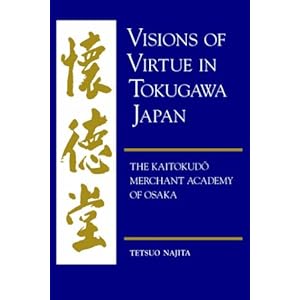
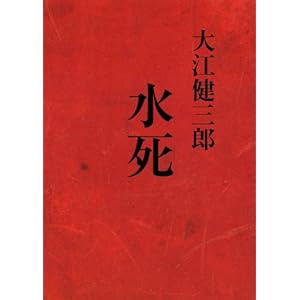
Oe revealed that Najita’s book was in many ways responsible for his most recent novel, Suishi (Death by water, 2009).??Najita’s study of the intellectual tradition of Osaka merchant culture opened Oe’s eyes to ways that his own father’s life could be understood as something other than a failure: it allowed him to make sense of his own father’s life and death, which in turn made it possible to realize his long-held desire to write a novel about his father’s death in a flood in 1945, just before the end of the war.
Oe praised Najita’s writing style for its warmth, rhetorical skill, and intellectual rigor. He then cited a talk Najita gave at a 2004 symposium in honor of Masao Miyoshi, in which Najita proposed a radical rethinking of the Japan’s “peace constitution” as being instead a “peace and ecology constitution,” a reinterpretation that would vastly expand the concepts of sovereignty. Oe said that he has frequently quoted this passage to great effect in talks he gives across Japan to groups organized to defend Article 9, the “no war” clause of the Japanese constitution, and he traced how Najita’s contemporary ethical claim was rooted in his historical scholarship on the eighteenth century thinker Ando Shoeki.
Oe concluded by celebrating what he called his “three American tutors”: Najita, Miyoshi, and Edward Said. He quoted a phrase Said used just before his death to describe the stance he sought to maintain despite the difficulties of today’s world situation: “optimism as an act of will.” It was a phrase, Oe declared, that applied to all three men.
We’ve videotaped the lecture and will post it on the Center for East Asian Studies webpage in the near future. In the meanwhile, I remain delighted and more than a little astonished to have been able to be a small part of such a meaningful and historic event.

He Keeps On Rollin’
In my freshman seminar on travel literature this past Thursday, we were discussing Jack Kerouac’s On the Road. We talked about the complexity of certain phrases or images in the book, how they take on multiple, often contradictory, meanings as the narrative progresses. For example, we looked at the meanings assigned to the Mississippi River, which Sal and Dean cross several times during the course of their travels. It is positioned simultaneously as that which both links and divides East from West in the spiritual and cultural geography of the book.
Then yesterday I was on an airplane flying from Chicago to Minneapolis. For a paper I’m writing on early Cold War culture, I was re-reading Lionel Trilling’s classic 1950 study of American literature, The Liberal Imagination. In his chapter on Mark Twain, he writes about the Mississippi, about how its brown, muddy presence functioned as something god-like in Twain’s imagination, a divine and sometimes vengeful presence that embodied the pure, natural power that Twain believed ruled in America prior to the high capitalism and corrupting influence of money that held sway after the Civil War. The antebellum Mississippi, Trilling writes, was a road that moved you, one that would crush you if you weren’t properly respectful of it.
As I was reading Trilling, the pilot announced that we were beginning our descent into Minneapolis-St. Paul. I looked up from my book to glance out the window and there it was: the Mississippi River. Of course it was white, flat and immobile now, a snowy ribbon twisting its way across southern Minnesota.
I’m up in Minnesota because we’re in the process of selling my mother’s house. It’s a trip full of various emotions. I write these words in the kitchen of the place I’ve called “home” since 1969, but it’s the last time I’ll be here. When we first moved in back when I was a third grader, we discovered to our delight that we were within walking distance of the Mississippi. As a grade schooler, I used to hike down to collect fossils from the limestone banks above the water. As a high school and college student, I used to pass evenings with friends down at the river’s edge, building bonfires and watching the barges slowly drift past. More recently, I’ve taken my own children with their grandparents down to the waterfront for picnics and to skip rocks across the river surface.
Change is bad. Luckily, the Mississippi has figured out a way around all of that.
Oe Kenzaburo at the University of Chicago
Below is the announcement for an event we’re pretty excited about here. The Independent newspaper (London) called Oe “the world’s greatest living novelist in any language.” I’ve just started reading his Suishi (Death by drowning, 2009)???which Oe says is likely to be his last full-length novel. It’s a compelling work in the vain of Natsukashii toshi e no tegami (Letters to a Sweet Bygone Year, 1987) or Jinsei no shinseki?(An Echo of Heaven, 1989): an aging novelist travels back to his birthplace in rural Shikoku to confront his own familial and literary past, in this case in particular the life and death of his own father.
Here’s the announcement:
will return to the University of Chicago to deliver this
year’s Tetsuo Najita Distinguished Lecture. ?e’s talk, “A
Novelist Re-Reads ‘Kaitokud??,’??? will take place on Thursday,
March 4 at 4:00 p.m. in the International House Assembly Hall.
?e will speak in Japanese, with English translation provided
by Norma Field, Robert S. Ingersoll Distinguished Service
Professor in Japanese Studies.
Born in 1935 in rural Shikoku, ?e is one of modern Japan’s
most respected novelists and public intellectuals. He began
publishing fiction while still a university student and in
1958 was awarded the Akutagawa Prize, Japan’s most prestigious
literary award. Since, he has published many celebrated
novels and stories, including A Personal Matter (1964), The
Silent Cry (1967), Teach Us to Outgrow Our Madness (1969), The
Pinch Runner Memorandum (1976), and Somersault (1999). His
most recent novel, Suishi (Death by Drowning), was published
in Japan to great acclaim in late 2009. His works have been
translated into many languages, and in 1994 he became the
second Japanese writer to win the Nobel Prize in Literature.
In addition to his fiction, ?e has throughout his career
provided a model for the engaged intellectual. He has written
widely on the dangers of nuclear proliferation, on Japan’s
history of military aggression, and in defense of Article 9,
the peace clause of Japan’s postwar constitution. Recently,
?e successfully defended himself in a highly publicized libel
case brought against him by the families of two Japanese
wartime military officers who claimed that ?e’s 1970 book
Okinawa Notes had exaggerated the role of the military in mass
civilian suicides in Okinawa during the closing months of
World War Two, with the judges in the case declaring that his
book had accurately depicted the events in question.
?e previously visited the University of Chicago as a visiting
scholar in the 1980s and the 1990s. During those earlier
visits, he became acquainted with Tetsuo Najita, Robert S.
Ingersoll Distinguished Service Professor Emeritus of History
and of East Asian Languages and Civilizations, and ?e has
written recently about the impact that Najita’s writings have
had on his own work. In his lecture, ?e will discuss the
contemporary relevance of Najita’s approach to intellectual
history, including Najita’s Visions of Virtue in Tokugawa
Japan: The Kaitokud?? Merchant Academy of Osaka (1997), a
landmark study of the rise of an independent school of
economic and moral philosophy in eighteenth-century Japan.
The Tetsuo Najita Distinguished Lecture series was launched in
2007 by the University of Chicago Committee on Japanese
Studies at the Center for East Asian Studies to honor the
legacy of Najita’s contribution to the university during his
long career.
?e’s lecture is free and open to the public. It is sponsored
by the Committee on Japanese Studies of the Center for East
Asian Studies.
God Save the (Cultural) Village Green
A few years back, as part of an ongoing project to rethink the works of novelist Natsume Soseki (1867-1916) in relation to the rise of modern regimes of property ownership, I wrote an article on him in relation to Mizuno Rentaro (1868-1949), chief architect of Japanese’s 1899 copyright law, a legal code that remained in effect — albeit with amendments — until 1970.
Under that law Soseki’s copyrights expired in the 1940s and his works entered the public domain. But in 1979, when Readers Digest Japan advertised a new series it was publishing that reproduced first editions of Soseki’s works, it found itself the target of multiple lawsuits filed by various publishing houses and other parties. The plaintiffs claimed that they held intellectual property rights in the physical appearance of those first editions. In essence, a moral right of authorship was being asserted for the acts of typesetting and printing of a book. As a result of out-of-court settlements in the Readers Digest Japan case, a new “right of reproduction” became standard in the Japanese publishing world. In a move the current U.S. Supreme Court would no doubt beam down upon with approval, the locus of the creative, original mental labor that was the original justification for copyright protection was shifted away from the personality of the author and onto the act of investment of the publishing house. Capital was granted the status of moral personality.
In a depressingly similar move, this week the NFL claimed ownership over the “Who Dat?” slogan used by fans of the New Orleans Saints football team. Though the phrase has a long history preceding the 1988 trademark registration filed by the team, the NFL is claiming exclusive authorship privileges and threatening to sue anyone who uses the phrase without permission. The NFL claim rests on very shaky legal ground; in fact, another business registered a trademark on the phrase several years before the Saints did, and the phrase has been in popular circulation for more than a century. But few small businesses or individuals have the financial capacity to engage in a court battle with a huge corporation like the NFL when it mounts this sort of intellectual enclosure.
This sort of situation is increasingly common in trademark law. Trademark originally was supposed to pertain only to specific, denoted meanings of a phrase, but increasingly legal decisions are expanding its domain to include secondary connoted meanings produced in the public commons by anonymous users of the phrase. Hence, McDonalds Corporation, for example, has claimed to own the nickname “Mickey D’s.” As legal scholar Rosemary Coombe notes:
The trademark owner is invested with authorship and paternity; seen to invest ‘sweat of the brow’ to ‘create’ value in a mark, he is then legitimately able to ‘reap what he has sown.’ The imaginations of consumers become the field in which the owner sows his seed—a receptive and nurturing space for parturition—but consumers are not acknowledged as active and generative agents in the procreation of meaning. The generation of new, alternative, or negative connotations are ignored, denied, or prohibited because patrilineal rights of property are recognized as exclusive: no joint custody arrangements will be countenanced.
(Coombe, The Cultural Life of Intellectual Properties: Authorship, Appropriation and the Law. Duke University Press, 1998, p. 71)
The author may be dead in literary studies, as we focus more on the dialogic process by which meaning is produced through the relationships between author, text, and the community of readers. But in trademark law, the High Romantic version of the Author as the seminal source of all Meaning remains alive–or, more accurately, undead, a kind of zombie creature that lives on by sucking the living blood of readers and, now, of football fans.
It’s another instance of what scholars like Kembrew McLeod (the man who trademarked the phrase “Freedom of Expression”) and James Boyle have attacked as the contemporary equivalent to the enclosure of public commons land during early capitalism. It’s depressing to watch Japan in recent years follow the lead of the U.S. (which in turn is following the lead primarily of the motion picture and television industry) and propose extending the length of copyright protection to seventy years. I’m not opposed to copyright per se, but we are seeing an alarming destruction of the public domain, assaults on the notion of fair use, and a general attempt to transform into private capital the cultural and intellectual discourse that by its nature must be shared in common.
1Q84: The Neverending Story
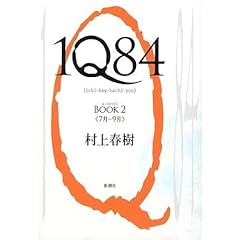
A few days ago, I finally managed to drag myself across the final page of the second volume of Murakami Haruki’s latest magnum opus, 1Q84. 1100 pages long, the story of budding novelist Tengo and female assassin Aomame starts out strong, but after a couple hundred pages, it felt like the fizz drained out of the tale. Even Murakami’s usual skill at polishing up gems of sentences seem to fade. I generally like Murakami’s works (I’ll be teaching the brilliant Sputnik Sweetheart this coming quarter, for example), but this one just didn’t do it for me. In particular, the second volume dragged on. And on. And on.
Now word comes that a third volume of the saga will be published in a couple of months. Granted, there are all sorts of loose plot ends to resolve (whatever happened to Komatsu, the editor, for example), but having only just escaped from the tome, I feel little real need to trace those through to some sort of conclusion. On the other hand, with 1100 pages of reading labor already invested in the narrative, can I afford not to read the conclusion when it appears? What is a harried professor of Japanese literature to do?
Maybe I’ll just go back and read 1973-nen no Pinball again. It’s shorter, for starters.
