

This and That: Science and Technology Edition
We enjoyed a quiet Easter. I managed to get to church — but cheated, in that my “worship service” consisted of the Art Hoyle Quintet performance at Hyde Park Union Church, sponsored by the always wonderful Jazz Sundays series organized by the Hyde Park Jazz Society.
Some interesting science and technology news that’s caught my eye lately:
The lunatic notion that genetic codes found in nature can be patented is finally facing skeptical court scrutiny, the New York Times reported last week. For the sake of culture and scholarship, we really need to curb the voracious appetite for infinitely expanding intellectual property claims, and this seems a modest step in the right direction.
Are the problems faced by scientists trying to gear up the Large Haldron Collider actually the work of a Terminator sent from the future in a desperate attempt to head off an unwelcome scientific development? The possibility has been suggested in a series of recent scientific papers, Time magazine reports.
Finally, a whole slew of new technological devices and digital scientific analytical techniques are being applied to baseball. The conclusion from statistical crunching of multi-angle digitized tracking of pitches over the course of an entire season? That good pitchers paint the corners, while bad ones hang it over the plate. Now they’re turning their attention to batters and defenders and will not doubt reach many revolutionary hypotheses, such as declaring that batters should try to hit the ball with the sweet spot of the bat and that fielders should try to catch the ball with both hands. Ah, the marvels of science.
In the meanwhile, play ball! The Twins kick off their season tonight in Anaheim.

Painting the Macroscopic and the Microscopic
Yesterday we had a few minutes to kill downtown before my daughter’s orthodontist appointment. As we often do when faced with that situation, we stopped by my favorite public space in America: the Chicago Cultural Center. There, we took in two current exhibits, both quite fascinating–and, unfortunately, both slated to close later this week.
“R&R (…&R)” is an exhibit of works by Susanne Slavick. She takes photographs of contemporary wartime destruction in Iraq, Afghanistan, and Lebanon and paints over them images from classical Islamic artwork, creating strikingly beautiful symbols of healing. One large panel, for instance, consisted of black-and-white photographs of bombed out cars, with colorful painted images of angels in the heavens pulling on ropes attached to the twisted hulks below. Slavick’s works give a sense of “restoration ” (one of the “R” words she has in mind in the exhibit title), and they also prod us toward a new awareness of our place in a global, millennial flow of history: I couldn’t help wondering how the images of our own violent times will look to human (or angelic) observers 500 years hence. The exhibit runs through April 4. You can see more of Slavick’s work here.

In a neighboring gallery we found “Up is Down: Paintings by Joel Sheesley.” In sharp contrast to Slavick’s macroscopic take on human history, Sheesley uses a microscope: his paintings depict small puddles in his back yard, with each water surface transforming into a mirror that reflects upward: ladders, clouds, people. The detailed images are often achingly beautiful, as Sheesley opens up an almost infinite sense of joy and wonder in the most mundane of (literally) backyard phenomena. The exhibit runs through April 3. Sheesley’s website is here.

The orthodontist appointment likewise turned out pretty well. I hope your Saturday morning brought you something splendid, as well–whether on a macroscopic or a microscopic scale.
On the Road Again
Good morning from Philadelphia, where I arrived late last night to attend the Association for Asian Studies Annual Meeting. I perhaps should say that I’ve “returned” to Philadelphia, since I was here on Monday and Tuesday for the NCC-3D conference, a large gathering of librarians, scholars and others who are concerned with the state of Japanese library resources in North America. As always happens when I get together with librarians and other information science people, I was impressed with the knowledge, passion, and commitment they bring to their professions. It was also exciting to learn about new developments in the field–the progress, for example, of the digitization project at Japan’s National Diet Library.
The other thing that became clear to me at the event, as it has at every recent scholarly event I’ve been to, is how much pressure everyone is facing in this time of slashed budgets, rising costs, and uncertainty about the future. These are challenging times for people who care about scholarship in North America–and in East Asia, too.
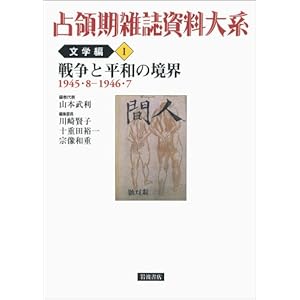
Yesterday, I was up at Princeton participating in the Workshop on Postwar Literary Criticism, the initial event in an exciting new collaborative research project that brings together faculty and students from the University of Chicago, Princeton University, and Waseda University. On the morning panel, Toeda Hirokazu (Waseda) presented some very intriguing ideas about how we should bring in the issue of censorship when we rethink literary criticism from early postwar Japan. He’s one of the editors of a new series of books that collects Occupation-period censorship records, and in his talk he showed us some remarkable instances of the conditions under which Japanese writers and editors functioned in the late 1940s.
Sakakibara Richi (Waseda) spoke on the 1946-7 “Politics and Literature” debate among leftist and Marxist critics, noting the implicit rise through the course of the debate of a series of shared concepts and keywords among participants who seemingly agreed about nothing. She also traced through how those same concepts and keywords meant something very different for the participants in the debate from what they mean today. I spoke about the same “Politics and Literature” debate as an early instance of Cold War culture, situating the works of such Japanese critics as Hirano Ken, Ara Masahito, and Nakano Shigeharu alongside that of some of their contemporaries in North America. In the afternoon, we had some excellent suggestions for the papers and projects from two discussants, Victor Koschmann (Cornell) and Richard Calichman (City University of New York). Then we had another terrific session in which graduate students from the three schools presented their thoughts about how to translate and annotate texts from early postwar literary criticism in ways that will address a variety of different kinds of readers.
The joint research project is off to an exciting start. We’ll bring the group together again for another workshop in Tokyo at Waseda this summer and then wrap things up with a formal international conference at Chicago next year. It’s the sort of project that makes you feel hopeful for the future, despite all the bad news about budgets that plague academic life in both Japan and North America these days.
The agenda for today is to carry out some sightseeing in Philadelphia with my daughter and to catch a panel at AAS tonight. Tomorrow morning I’ll visit another panel or two, visit the publishers’ exhibition hall to say hello to some editors I work with, and we’ll be on a plane back to Chicago tomorrow afternoon.
Finally, say “happy birthday” to one of my childhood heroes. I’m going to have check out that new DVD set….
This and That
The sumo tournament in Osaka has reached the midway point, and as expected sole yokozuna Hakuho (7-0) has dominated. But two promising rikishi have also stepped up to take advantage of the opening created by yokozuna Asashoryu’s sudden retirement last month: ozeki Harumafuji, the former Ama and a disappointment since his promotion to ozeki a couple of years back, is now 7-0, as is sekiwake Baruto, who could win promotion to ozeki with a championship in this tournament. Baruto in particular has been impressive: he just looks much more serious about things this time around, his goofy grin a thing of the past. Down in the maegashira ranks, Tokitenku is also 7-0, but that’s just a bunch of smoke and mirrors.
In the meanwhile, spring has arrived in Chicago (never mind those snowflakes falling outside the window as I write these words). I celebrate by listening to Minnesota Twins spring training games in the afternoon at my office. I’m pretty optimistic about the coming season, despite noises being made by local White Sox fans….
In the category, “It’s bloody well about time”: Universal betting on lower prices to boost CD sales.
Ray Davies continues to wow them on his current tour. MSN.com reports that “Ray Davies rules on second night of SXSW.”
The coming week should be a hectic one for me. I’m in Philadelphia on Monday and Tuesday for the NCC 3D conference, then up to Princeton for the “Rethinking ‘Hihyo’: Postwar Literary Criticism and Beyond” workshop, then back down to Philadelphia on Thursday for the 2010 AAS Annual Meeting.
I leave you with the late Alex Chilton. I saw him play with the reunited Big Star seven or eight years ago at Royce Hall on the UCLA campus. It was a joyous occasion, especially when they covered The Kinks’ “‘Till the End of the Day.” Ray Davies dedicated that song to Chilton in his performance at SXSW this week (where Chilton had been scheduled to play) and spoke from the stage about how Chilton had visited him in the hospital after he was shot in New Orleans. A great songwriter and a wonderful voice: so long, Mr. Chilton.
Oe Kenzaburo at Chicago Redux
Here’s a scan of a very nice column (Japanese-language only) that Oe Kenzaburo published in yesterday’s Asahi newspaper about his visit last week to the University of Chicago. (Click on the image to get a larger version).

Check Out the Shoes
Granted, this may be taking my Kinks mania in an entirely unhealthy direction, but just check out the shoes Ray wore at his gig in Kansas City last night (full review of the show here). I thought it was pretty cool when for my birthday last year my wife and daughter finally gave me those Converse low-top black sneakers I’d been lusting after forever and ever, but after this they seem pretty small potatoes.

Summer Memories….
I graduated from high school in the summer of 1979. It was a private prep academy that I attended on a full scholarship: we were on various forms of public assistance during my teens, and my mother could never have afforded tuition. Primarily because of my sense of humor, my classmates elected me as the class speaker for our graduation ceremony. They expected a funny talk, but I was feeling rebellious. After four years of frustration over the elitism, status hierarchies, and general smugness of the local ruling class, I decided to let the school have it in my speech.
In my own narcissistic mind, this made me quite the heroic figure. Apparently, not everyone agreed. For starters, the speech didn’t make me very popular with school administrators or teachers (they launched a new policy requiring prior review of graduation speech texts the following year), and it angered a number of my classmates as well. But there were at least a few people who believed I’d gotten it right.
I met one of those at a party a few nights later. I’d arrived that evening with a couple of buddies, and we all immediately noticed an incredibly beautiful woman there, someone none of us had ever seen before. She was so attractive that we all sat around trying to figure out who she was: there seemed no point in talking about anything else. Someone said she was a friend of one of our classmates.
I was astonished a few minutes later when this angelic figure walked up to me and told me she had heard my speech and admired the way I had spoken truth to power. She introduced herself as Darcy Pohland, and to my great joy (and to my friends’ envy) we spent the rest of that evening talking. She gave me her phone number and we arranged to meet up again the following evening.
I was smitten. We quickly tumbled into a summertime romance. From the start, Darcy and I were utterly mismatched: she grew up in a well-to-do suburb and I in a working-class city neighborhood, she drove her own shiny red sportscar, whereas my family shared an old clunker–and in fact for stretches of my teen years we had no car at all. I was into underground punk rock, while her favorite band was the Doobie Brothers. I mean, come on: the Doobie Brothers?
But she was also overflowing with vivacity, intellectual curiosity, and a hunger for life. She had a role in a community theater production of “South Pacific” that summer, and I used to pick her up after rehearsals for a late night snack. I also remember taking her to a Minnesota Kicks soccer game out at Metropolitan Stadium and feeling more than a little jealous when every jock partying in the parking lot seemed to know Darcy.
It lasted maybe five or six weeks. I wanted a more serious relationship and she wasn’t ready for that. I left town on a road trip with friends through the western U.S. and when I returned to Minnesota in late July Darcy and I were finished as an item.
I never saw her again in person after that. I heard a few years later from a friend of a friend that she’d had a terrible accident: she’d mistakenly dived into the shallow end of a swimming pool and broken her neck. She would remain a paraplegic for life. How sad, I thought.
But then, a dozen or so years after that, I was up in Minnesota watching the channel 4 news when who should appear but Darcy Pohland. Despite the challenge of life in a wheelchair, she’d made it as a television reporter. Over the decade that followed, I’d see her news reports from time to time when I was back home, and from the way her on-air colleagues and interview subjects treated her, it was obvious that she’d earned tremendous respect. Through sheer determination, she’d managed to build a happy ending out of what could have been a tragic story.
I learned Friday morning that Darcy had passed away unexpectedly in Minnesota. The comments sections from the on-line newspaper reports are overflowing with affectionate tributes and show the love she’d earned from people across Minnesota.
My memories of that summer of 1979, those first months after high school graduation, come tinged with a shimmering glow, and Darcy is a part of that. Summertime, and the living’s easy…. The warm nostalgic feeling that now surrounds those memories helps ease the fact that in them I am also confronting my own mortality. I have one more thing to thank Darcy for: she became one of the models for the main female character in “Sister Carrie,” a short story I published many years ago.
Rest in peace.
[Postscript: WCCO-TV has now posted a nice story about Darcy Pohland’s high school days. Video here.]
He Keeps On Rollin’
In my freshman seminar on travel literature this past Thursday, we were discussing Jack Kerouac’s On the Road. We talked about the complexity of certain phrases or images in the book, how they take on multiple, often contradictory, meanings as the narrative progresses. For example, we looked at the meanings assigned to the Mississippi River, which Sal and Dean cross several times during the course of their travels. It is positioned simultaneously as that which both links and divides East from West in the spiritual and cultural geography of the book.
Then yesterday I was on an airplane flying from Chicago to Minneapolis. For a paper I’m writing on early Cold War culture, I was re-reading Lionel Trilling’s classic 1950 study of American literature, The Liberal Imagination. In his chapter on Mark Twain, he writes about the Mississippi, about how its brown, muddy presence functioned as something god-like in Twain’s imagination, a divine and sometimes vengeful presence that embodied the pure, natural power that Twain believed ruled in America prior to the high capitalism and corrupting influence of money that held sway after the Civil War. The antebellum Mississippi, Trilling writes, was a road that moved you, one that would crush you if you weren’t properly respectful of it.
As I was reading Trilling, the pilot announced that we were beginning our descent into Minneapolis-St. Paul. I looked up from my book to glance out the window and there it was: the Mississippi River. Of course it was white, flat and immobile now, a snowy ribbon twisting its way across southern Minnesota.
I’m up in Minnesota because we’re in the process of selling my mother’s house. It’s a trip full of various emotions. I write these words in the kitchen of the place I’ve called “home” since 1969, but it’s the last time I’ll be here. When we first moved in back when I was a third grader, we discovered to our delight that we were within walking distance of the Mississippi. As a grade schooler, I used to hike down to collect fossils from the limestone banks above the water. As a high school and college student, I used to pass evenings with friends down at the river’s edge, building bonfires and watching the barges slowly drift past. More recently, I’ve taken my own children with their grandparents down to the waterfront for picnics and to skip rocks across the river surface.
Change is bad. Luckily, the Mississippi has figured out a way around all of that.
Scary Disney Rides
It must have been 1998 or thereabouts. Walter was 7 and Sonia was 2, and we were living in Los Angeles. One winter Sunday morning, we got up early and drove down to Anaheim, timing it so we arrived at Disneyland just as the park opened. The thought, of course, was to beat the crowds.
We rush in through the entrance gate and there is no one, I mean NO ONE, there. I tell the kids, quick, let’s jump onto as many rides we can before the long waiting lines form. I don’t care what rides: just anything, while there is no waiting. Without thinking, we rush into the Peter Pan attraction. It isn’t a good choice: we end up riding through the dark with mechanical pirates popping up and threatening to attack us. Sonia breaks down into hysterical wailing. Even big brother Walter is a little shaken up. Who would have thought a Peter Pan ride could be so intense?
After that, Sonia is leery of any rides. It takes a good deal of coaxing and persuading, but we get her to ride the spinning teacups, the flying Dumbos, and one or two others. And then I think: “It’s A Small World.” What could be safer?
By now the park is pretty crowded. We have to stand in line at “It’s A Small World” for maybe twenty, thirty minutes. All the while, I’m telling Sonia how much she’s going to like this one. Finally, we get into the little boat. We start moving forward through the channel, slow and gentle. Everything’s fine. But then we enter into a dark room. Sonia tenses up. Next we turn the corner and are suddenly surrounded on all sides by hundreds of little horrific dolls, all singing in diabolic voices, “It’s a small word after all…,” all of them swiveling in this robotic jerky back-and-forth movement. Sonia screams in terror for the rest of the ride, completely inconsolable.
I’ve learned this week that Sonia isn’t the only one to get freaked out about “It’s A Small World.” Greg Kot in the Chicago Tribune interviewed rising UK singer Ebony Bones this week. He asks about her striking look, and she describes her style as being like “a dark Disney ride.” Kot pursues this issue further:
Did she ever experience a dark Disney ride?
“Absolutely! My parents took me when I was 9 and it was vile. I hated it. The ‘It’s a Small World’ ride terrified me: All these kids from strange countries staring at me. I wanted to jump off the ride.???
I don’t know if St. Vincent had any bad Disney experiences while growing up. She seems pretty well adjusted. Anyhow, I really like what she does to the Beatles’ “Dig a Pony.”
Gargoyles and Eccentricity

When I first arrived here in Chicago a couple of years back, I managed to offend one of my new colleague’s sensibilities. We were walking across campus together when this respected scholar asked me if I didn’t simply love the architecture of the university’s buildings. Without thinking, I replied that I thought it was a little silly. Here in Hyde Park, a neighborhood studded with masterpieces of Prairie School and other early-twentieth-century styles of American design, why had the Rockefellers and the university administration decided to build in the Gothic style, as if Hyde Park were thirteenth-century Cambridge or Oxford? It reminded me a little of the Magic Kingdom in Disneyland.
I could tell by my colleague’s facial response that I’d said the wrong thing — I have practice in recognizing that look, given the number of times I put my foot in my mouth in the average day.
Since then, I’ve come to appreciate the campus’s beauty a bit more, especially in summer when everything is in bloom. Most of all, I like the gargoyles that keep watch over us from the turrets and arches of the buildings on the main quad.
Yesterday, my daughter and I trekked over to Rockefeller Chapel — the most Gothic of all the campus buildings — for the opening reception for “That Gargoyle on My Shoulder.” The exhibit brings together gargoyle-related works by local and national artists, including paintings, photography, and sculpture, all of which look remarkably at home in the looming chancels of the chapel. One inventive piece pairs two small paintings in round frames, one of a conventional gargoyle mounted on a cathedral tower, the other depicting a modern video surveillance camera in the same position. We’re still being watched from on high, the piece reminds us.
The exhibit also includes some thirty papier-mâché gargoyles produced over the past five or six years by sixth graders at the University of Chicago Lab Schools–including one done a couple of years back by my daughter Sonia, pictured above. Here’s the planning sketch she did for it, which now hangs in a prominent position on our walls at home.

A review of the exhibit in the Chicago Maroon newspaper praises the student works as “impressive” and concludes
Sixty beady eyes observing your every move certainly has the potential to be unnerving, but That Gargoyle on My Shoulder manages to unite the grotesque with the whimsical for an overall experience that is quite positive. The elephant-eared, tentacled, long-snouted beasts that adorn the inner walls of the chapel make the space a little eccentric, quite inventive, and very exemplary of the U of C.
That’s the word I should have used two years ago: not “silly,” but “eccentric.” It would have reduced the awkwardness of the moment, and it also would have been more precise.
The show runs through March 19, and they promise to serve hot chocolate to visitors. If you’re in the neighborhood, stop by and check out the eccentric vibe.
