

Online Companion for Sayonara Amerika, Sayonara Nippon

I’ve created an online companion for readers of my book, Sayonara Amerika, Sayonara Nippon: A Geopolitical Prehistory of J-Pop, including sound samples, links to video clips, and other goodies. You can check it out here. If you have any suggestions for improvements or additions, please send them along.
In addition to paperback and hardcover, the book is now also available on I-Tunes as a download for the I-Pad, I-Phone, and I-Pod Touch. It’s also available for Kindle downloads.
In the meanwhile, the Japan Times newspaper (13 May 2012) has run a nice review of the book by Kris Kosaka. Kosaka concludes:
Stylistically, Bourdaghs’ work beats consistently up-tempo, direct, clear prose revealing his nearly 35 year engagement with Japan. Bourdaghs’ analysis reads quickly yet fully covers an important historical span of modern Japan. With the Japanese translation to be in published in June by Byakuya Shobo Publishers, Bourdaghs’ work will soon be heard by Japanese audiences as well. For music, history, or cultural fans of contemporary Japan, this book is a chart-topper.
You can read the full review here.

This and That: New J-Pop Stuff
Now that her band Tokyo Incidents is history, Shiina Ringo isn’t standing still. She has a new single out, “Jiyu e michizure,” in which she taps into her punky shrieking-guitars vein. I kinda like it:
J-Rock veterans Grapevine will be providing a free live Ustream feed on May 2 of the final date from their current concert tour, direct from Club Quattro in Shibuya. Details here.
The fine blog, “Make Believe Melodies: The Latest On Music From Every Corner Of Japan,” tipped me off to Ç86, a free download compilation of current indies’ rock bands from Japan, available from International Tapes. Uneven, of course, but it includes some good stuff, and you can’t beat the price.
Rodrigo y Gabriela vs. Southern All Stars
Last week, we attended a terrific sold-out show by Rodrigo y Gabriela at the Chicago Theatre. For the most part, I agree with Greg Kot’s concert review in the Chicago Tribune. The concert began with the duo backed by a band of supporting musicians from Cuba–but a bad mix often drowned out the guitars, especially Gabriela’s. The band departed the stage after five or six numbers, and then we got to the highlight of the show: two excellent, versatile guitarists strutting their stuff, and I do mean “strut.”
Another highlight was the occasional patter between songs. Rodrigo went first, and then a few numbers later Gabriela stepped up to the mike. She apologized that she might be repeating things Rodrigo had already said, “but I never listen when Rodrigo’s talking.”
The band came back for the final set of numbers, and the sound was much better this time around. The concert came to a rousing conclusion with “Tamacun,” followed by an extended encore (including a teaser version of “Stairway to Heaven,” the group’s viral video hit).
I like “Tamacun” quite a bit, but I also notice a strong resemblance to another song: the Southern All Stars’ 1996 hit “Ai no kotodama.” Or am I perhaps just hearing the shared Latin roots of both bands?
You can decide for yourself. Here’s Rodrigo y Gabriela performing “Tamacun”:
And here are the Southern All Stars with “Ai no kotodama.”
The Politics of Group Sounds Revisited
In my book, Sayonara Amerika, Sayonara Nippon: A Geopolitical Pre-History of J-Pop, I trace the hints of coming revolution that seemed to reverberate within guitar noise in Japan circa 1968–and the ultimate absorption of that political edge into the new commercialism of 1970s rock. My primary focus in that section of the book is on “Group Sounds,” the Japanese version of 1960s rock–teen-idol bands like the Tigers, the Spiders, and the Tempters.
As culture industry commodities, mainstream Group Sounds bands remained resolutely apolitical. So it’s a pleasant surprise to encounter the latest recordings by Sawada “Julie” Kenji, former lead singer of the Tigers and a very successful solo act since the early 1970s. After the breakup of the Tigers, Sawada enjoyed a string of solo hits–mostly pop ballads that traded on his flamboyant image (something akin to, say, Elton John)–but you didn’t turn to “Julie” expecting biting political commentary.
That’s all changed now. Check out, for example, the very catchy “F.A.P.P.” (the initials stand for Fukushima Atomic Power Plant), a resolutely anti-nuke song on Sawada’s new maxi-single, “Sangatsu y??ka no kumo” (The clouds on March eighth):
And if you think it’s just a one-off deal, here is Sawada’s gospel-tinged defense of Article 9, the anti-war clause of the Japanese constitution: “Waga ky?j??” (the title revolves around a pun: ?????????? vs. ??????????????, ‘My pain’ vs. ‘My Article 9’):
Good on you, “Julie.” GS, I love you.
Today’s Musical Discovery
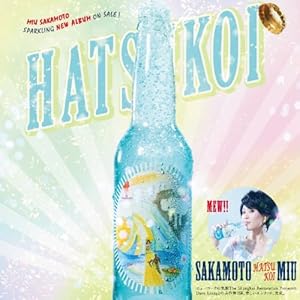
This morning, I poked my head in at the website for the World Happiness music festival to see who was on the bill this year. This is the annual one-day event organized by Yellow Magic Orchestra, with YMO as headliners and a changing roster of supporting artists, all hand-picked by YMO. We very much enjoyed the 2010 edition, and we might well be in Tokyo again this August.
This year’s show will take place on August 12. In addition to YMO, the artists on the bill announced so far include Grapevine, Original Love, Tokyo No. 1 Soul Set, and Sakamoto Miu. The last name was entirely new to me, so I did some checking around. Then it clicked: I’d heard in the past from friends that the daughter of Sakamoto Ryuichi (YMO) and Yano Akiko was also a musician. It’s her, of course.
Born in 1980 during the heyday of YMO’s fame, Miu released her first full album in 1999. She now has six albums to her credit, include the just-released Hatsukoi. The latter includes her latest single, on which she sounds very much like a genetic hybrid of her mother and father’s styles.
Perhaps I’ll be hearing more of her work this August in Yumenoshima Park in Tokyo.
Featured Book of the Week
Sayonara Amerika, Sayonara Nippon: A Geopolitical Prehistory of J-Pop is the “featured book of the week” on the Columbia University Press blog. Among other things, they’re giving away a free copy, but hurry: the contest ends this Friday. Details are available here.
In celebration, let me leave you with “To My Dear Friends” (Waga yoki tomo yo), a 1975 hit for Kamayatsu Hiroshi. Kamayatsu is one of the heroes of my chapter four, “Working within the System: Group Sounds and the Commercial and Revolutionary Potential of Noise.” The tune, composed by Yoshida Takuro, was the biggest hit of Kamayatsu’s solo career, which followed his stint as resident musical genius for 1960s’ garage rockers, The Spiders.
Kamayatsu was the son of Tib Kamayatsu, a Japanese-American jazz singer whose career in Tokyo dated back to the 1930s. He debuted in the late 1950s as a country-western and rockabilly singer before joining the Spiders. He was one of the first Japanese rock-and-rollers to really “get” the new Merseybeat sound when it exploded onto the scene in 1964 and went on to compose many of the Spiders’ hits. In his seventies now, “Monsieur” Kamayatsu remains an active force on the Japanese music scene today. One of my biggest thrills as a music fan came in 2006, when I ended up sitting a couple of rows away from him in the balcony for a show by the reunited Sadistic Mika Band. It took enormous will power to stop me from cornering him to gush about how much I love his work.
Incidentally, Kamayatsu was (and is) a huge Kinks fan. Listen to the opening riff from the Spiders’ 1966 recording of “Little Roby,” lifted more or less directly from the Kinks’ “Set Me Free.”
Detroit Metal City

This 2008 film came up in a discussion yesterday following a workshop I led at DePaul University for K-12 teachers on using Japanese popular music in the classroom. I did a little web surfing after getting home and learned that it is now available on DVD in North America.
It’s a funny, cartoonish (not surprising, since it’s based on a successful manga) movie about a sensitive singer-songwriter (Matsuyama Ken’ichi) who wants only to record sunny Shibuya-kei style ballads about love and trendy Tokyo lifestyles, but who ends up trapped as lead singer for a death metal band. His fans worship him as the spawn of Satan, but all he cares about is trying to win over the squeaky clean girl (Kato Rosa) he’s had a crush on since college. Gene Simmons turns in a nice cameo appearance as the legendary American death metal icon who challenges our hero to a final showdown for supremacy.
Everything is played in a silly, over-the-top manner, dulling the emotional impact when it tries to go sentimental at the end. But the pop and metal songs are fun, affectionate parodies of the two genres. Around the time the movie came out in Japan, they actually released CDs purporting to be music by the fictional bands from the film.
Mark Schilling’s review for the Japan Times is available online here. Here’s a trailer for the film:
Re-Staging “101st Proposal” in the Edo Period?

As unlikely as it may seem, the hit 1991 Fuji Television series 101st Proposal (see chapter six in my Sayonara Amerika, Sayonara Nippon) is being revived next month as a stage play in Fukuoka. Takeda Tetsuya and Asano Atsuko will revive their roles from the original series–but the story is being reworked into a jidaigeki: a samurai drama set back in the Edo period.
The Asahi newspaper reports (Japanese-language only) the play will run at the Hakata-za theatre in Fukuoka, March 2-28, with possible runs in Tokyo and elsewhere to follow. No word on whether the piece will include a shamisen version of the theme song from the show, Chage & Aska’s “Say Yes.”
Now Available: Sayonara Amerika, Sayonara Nippon–The Book

My new book, Sayonara Amerika, Sayonara Nippon: A Geopolitical Prehistory of J-Pop, has just been published by Columbia University Press. It’s available in paperback through your local neighborhood bookstore, and there’s also a Kindle e-book version. Readers in Japan can order it through www.amazon.co.jp
Stay tuned: I’ll soon be adding a web feature over at www.bourdaghs.com including sound samples and other online resources relevant to the book.
Meanwhile, to whet your appetite, here’s Kasagi Shizuko (the heroine of chapter one) performing her signature number, “Tokyo Boogie Woogie”:
Counterfeiting China in 1930s Japan Pop Songs
An article I wrote about “continental melodies,” a 1930s genre of pop songs from Japan that mimicked China and Korea, has just been published. Taking their cue as much from Tin Pan Alley Orientalism as from contemporary “Yellow Music” on the continent, these seductive tunes enjoyed massive popularity in Japan during the early years of its war with China.
My essay, “Japan’s Orient in Song and Dance,” is included in the volume Sino-Japanese Transculturation: Late Nineteenth Century to the End of the Pacific War (Lexington Books, 2011), edited by Richard King; Cody Poulton and Katsuhiko Endo. In it, I try to rethink the genre through the lens of recent cultural studies work on American black-face minstrel shows. Here’s how I set up my interpretation of the genre:
Here, I take up a popular music genre that was closely associated with Ri K??ran [an enormously popular wartime Japanese singer and actress who “passed” as Chinese], but which aimed at a subtly different effect. I will look at three singers in particular: Watanabe Hamako, on whose hit song the movie Shina no yoru was based; Hattori Tomiko, who played a Japanese woman in that same film (for which her brother Hattori Ry??ichi composed the score); and Kasagi Shizuko, who as Ry??ichi’s protégé would emerge in the postwar era as the Japanese Queen of Boogie Woogie but who began her recording career a decade earlier. All three recorded tairiku merodei (??????, continental melodies), a genre that enjoyed enormous popularity in the years following the 1937 Marco Polo Bridge incident. These songs incorporated Orientalist elements, both musically and lyrically, to signal fantasy forms of Chineseness. Moreover, Hamako and Tomiko in particular would sometimes appear in Chinese dresses with Chinese hairstyles and all three would occasionally sing phrases in Chinese. Hamako even recorded cover versions of Chinese songs. Despite these Orientalist flourishes, though, no one would ever mistake these singers for Chinese. Their performances included elements believed to be Chinese, but unlike Ri K??ran they made no attempt to “pass.??? In fact, a large part of the enjoyment of their performed Chinese-ness lay in the unmistakable fact that the singers were Japanese. In other words, these performers engaged in a game of masquerade, and their songs produced pleasure by openly acknowledging their counterfeit status. What sort of Japan-China relationship did this genre of explicitly counterfeit culture entail?
You can watch Watanabe Hamako, the “Queen of Continental Melodies” perform her signature number “Shina no yoru” (China Nights, 1938) here.??You can also listen to jazz singer Kasagi Shizuko’s delirious “Hotto Chaina” (Hot China, 1939) here. And let me leave you with a contemporary performance by Hattori Tomiko of her 1938 hit “Manshu Musume” (Manchurian Girl), with Tomiko decked out in full Orientalist trimming:
