

A Novelist Re-Reads Kaitokudo
I had the honor and pleasure yesterday of introducing and serving as interpreter for Oe Kenzaburo, 1994 Nobel Laureate in Literature, in this year’s installment of the Tetsuo Najita Distinguished Lecture series here at the University of Chicago. Professor Najita was in attendance, too, and it turned into a very moving tribute from one old friend to another.
Oe took up Najita’s landmark study, Visions of Virtue in Tokugawa Japan: The Kaitokudo Merchant Academy of Osaka, and traced its impact on his own life and writing. It turns out that Oe’s own Great Grandfather studied at a merchant academy much like the Kaitokudo in nineteenth century Osaka, where the Confucian concepts of “kogi” (ancient meanings) and “gi” (righteousness) were crucial. An old school building his Great Grandfather erected that still stands on the grounds of Oe’s family home in Shikoku has hanging on its wall calligraphy samples of those two phrases, and Oe himself ended up using those words frequently as the names for characters in his novels.
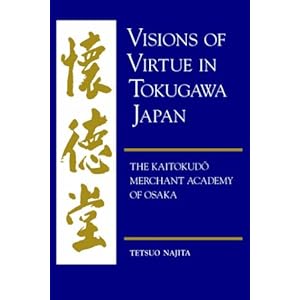
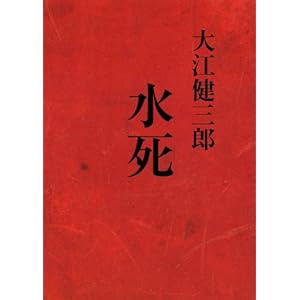
Oe revealed that Najita’s book was in many ways responsible for his most recent novel, Suishi (Death by water, 2009).??Najita’s study of the intellectual tradition of Osaka merchant culture opened Oe’s eyes to ways that his own father’s life could be understood as something other than a failure: it allowed him to make sense of his own father’s life and death, which in turn made it possible to realize his long-held desire to write a novel about his father’s death in a flood in 1945, just before the end of the war.
Oe praised Najita’s writing style for its warmth, rhetorical skill, and intellectual rigor. He then cited a talk Najita gave at a 2004 symposium in honor of Masao Miyoshi, in which Najita proposed a radical rethinking of the Japan’s “peace constitution” as being instead a “peace and ecology constitution,” a reinterpretation that would vastly expand the concepts of sovereignty. Oe said that he has frequently quoted this passage to great effect in talks he gives across Japan to groups organized to defend Article 9, the “no war” clause of the Japanese constitution, and he traced how Najita’s contemporary ethical claim was rooted in his historical scholarship on the eighteenth century thinker Ando Shoeki.
Oe concluded by celebrating what he called his “three American tutors”: Najita, Miyoshi, and Edward Said. He quoted a phrase Said used just before his death to describe the stance he sought to maintain despite the difficulties of today’s world situation: “optimism as an act of will.” It was a phrase, Oe declared, that applied to all three men.
We’ve videotaped the lecture and will post it on the Center for East Asian Studies webpage in the near future. In the meanwhile, I remain delighted and more than a little astonished to have been able to be a small part of such a meaningful and historic event.


on March 5th, 2010 at 2:22 pm
It really was a successful speech and it broadened my understanding to Prof. Najita’s books. Thank you very much for the interpretation.
I was directed to here by googling the phrase “optimism as an act of will.” When I heard it yesterday I thought the word “will” was just referred to “desire” or “hope”, but after a second thought, I had this hypothesis that this “will” might refer to another thing, that a “wil” entrusted by someone who is leaving this world. Sadly, my Japanese is too bad to understand in what way Mr. Oe used this term. Neither could I find in what circumstances Said used this phrase.
Maybe I am just overinterpreting but I can’t helping sensing a concealed sadness in his speech, especially when he talked about Said, Miyoshi Masao and Najita (who has been fighting with illness for years). Like Said, Oe himself is being devoted to a battle (Constitusion and Art. 9) which, perhaps, is very hard to win. That action–to protect kogi and jingi, like what Kaitokudo scholars did 200 years ago–has true beauty in itself. Isn’t this bueaty,”in today’s world situation”, a representation of mono-no-awa-re?
Thank you again and hope can have your opinion on that.
on March 5th, 2010 at 5:54 pm
Thanks for your comment, Nianshen. The Japanese word Oe used for Said’s “will” was “ishi” (????), with the sense of ‘resolve’ or ‘intention.’ As you note, though, there was a touch of nostalgia throughout the talk, though and a sense of sadness at the difficulty of maintaining “a quiet metaphoric reminder” (Najita’s words) of the importance of light, reason, and ethicality. I’m glad you were inspired by the speech, as was I.