

Engaging Commodities, Day 1
Our conference, “Engaging Commodities: Crossing Mass Culture and the Avant Garde in 1960s Japanese Film, Music and Art” got off to an exhilarating start yesterday. In the afternoon, we had our first panel, “Popular Music as Engaged, Popular Music as Commodity.” James Dorsey (Dartmouth) spoke on how the censorship of protest folk singer Okabayashi Nobuyasu actually generated new opportunities for creative agency on the part of musicians, audiences, and the music industry. Christine Yano (University of Hawaii) presented on the great enka diva Misora Hibari as a figure of “jet set culture,” in whose work a musical cosmopolitanism existed in tandem with an increasing sense of cultural nationalism. Michael Molasky (Hitotsubashi University) explored the changing meaning of “jazz” in Japan from the late 1950s through the 1960s, especially with an eye toward the rise of the “jazu kissa” (jazz coffeehouse) as a crucial institution in the rise of the “modern jazz” of such figures as Miles Davis and Art Blakey.
The evening program began with a talk session with musician Alan Merrill, who was active in Japan from 1968 to 1974. He told remarkable stories about his days with the Group Sounds band The Lead, as a solo performer under the management of the all-powerful Watanabe Pro agency, and as the founder of the pioneering glam rock band Vodka Collins. He wrapped up his presentation with a terrific acoustic set of some of his best-known compositions, playing “Sands of Time” and “Automatic Pilot” from his Vodka Collins days before closing with a high-energy rendition of “I Love Rock ‘n’ Roll,” the song he wrote and recorded with his band The Arrows in 1975 and that later became a worldwide hit for Joan Jett and others.
Alan brought down the house–and we were just getting started. Following his set, we screened the terrific documentary, The Golden Cups: One More Time, about the legendary Yokohama Group Sounds band. This was followed by a lively question-and-answer session with three original members of the Golden Cups: Eddie Ban (lead guitar), Louise Louis Kabe (bass), and Mamoru Manu (drums). We had a large delegation of Cups’ fans in the audience, including people who had traveled from Japan, Florida, and elsewhere to be there, which all added to the sense that something very special was happening. The evening closed with a jam session between Eddie Ban and Alan Merrill, as they performed “Sweet Home Chicago,” “Namida” (Alan’s 1969 solo hit), and finally “Route 66.”
I’m extremely grateful to Alan Merrill, the Golden Cups, the people from Altamira Pictures and Altamira Music who made the arrangements to bring the Cups over from Japan, the fans and scholars: everyone who made this memorable day possible. Next up is day two, when we turn our focus to film and art….
Alan Merrill with Vodka Collins, “Sands of Time” (1972)
The Golden Cups’ astonishing 1968 recording of “Hey Joe”; pay special attention to Louise Louis Kabe’s blazing bass lines:

Arakawa Shusaku
When I was a visiting professor at International Christian University in Tokyo (2005-2007), on my way home from campus I used to walk past a queer building. It was obviously an apartment building of some sort, but it was a striking conglomeration of strange shapes and vivid colors, like something designed by Dr. Seuss. My curiosity was piqued, and some on-line exploration told me that this was in fact Reversible Destiny Mitaka, a new art project by Arakawa Shusaku and Madeline Gins.
The press is reporting today that Arakawa passed away on Wednesday. The news is both sad and ironic: Arakawa vowed that his work was “architecture against death,” and he and Gins famously announced for an exhibit that “we have decided not to die.” It is also ironic, because today at the University of Chicago we begin “Engaging Commodities: Crossing Mass Culture and the Avant Garde in 1960s Japanese Film, Music and Art,” a conference exploring figures like Arakawa, who troubled the boundaries of art, commerce, and scholarship to generate a remarkable moment in global cultural history.
Of course, Arakawa lives on — in his impact, in our conference, and, surely not least of all, in the Reversible Destiny Mitaka buildings:
Vodka Collins, “Automatic Pilot”
Alan Merrill, leader of the legendary Japanese glam rock band Vodka Collins, will be speaking at the University of Chicago this coming Friday. Also on the bill: The Golden Cups. To RSVP for a seat, click here.
Here is Vodka Collins with the classic Merrill composition, “Automatic Pilot,” from 1972. No wonder David Bowie stole their costume designer….
Midway Point at the Kokugikan
The current Summer Sumo tournament in Tokyo has reached the halfway point. It’s been insanely busy around my house, so I’ve managed to watch just a couple of days–and then only by using the fast-forward button judiciously. It’s not the best way to watch sumo, since you lose touch with the ritual pacing that is so central to the sport’s charm. But skipping past all the time between bouts also allows you to condense an entire day’s worth of top division matches, which in real time takes ninety minutes, into about fifteen minutes.
The most poignant fact about the current tournament was reported in the press (Japanese-language only) just before it got underway. If you’ve ever visited the Kokugikan to watch matches, you’ve seen the grand array of enormous (3.17 by 2.28 meters) portraits of past champions hanging around the upper tier of the arena. There are 32 in all, and with each tournament they take down the oldest and replace it with a portrait of whomever won the most recent title. As a result, with six tournaments a year, the display gives you a nice snapshot of the last five-plus years in the sport’s history. Here’s an article about the portraits.
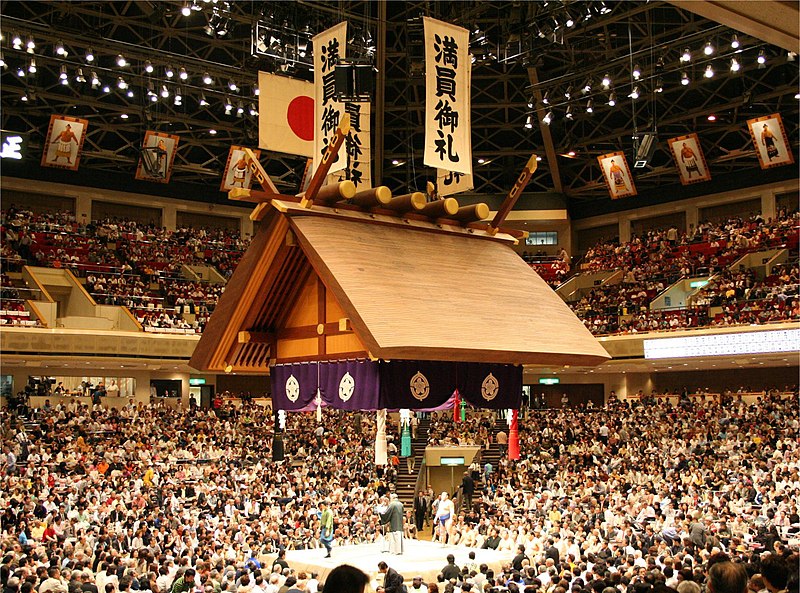
Just prior to the current tournament, to make room for Hakuho’s portrait celebrating his victory in Osaka this past March, they took down the portrait of Kaio commemorating his championship in the Autumn 2004 tournament. As a result, right now of the 32 portraits hanging in the Kokugikan only one is of a Japanese wrestler–Tochiazuma, celebrating his upset win in the 2006 New Year tournament. The rest are all Mongolians–with the exception of one that portrays Bulgarian ozeki Kotooshu. It’s all enough to make a nationalist weep.
It isn’t going to change this time around. Mongolian yokozuna Hakuho has things firmly in hand so far with an 8-0 record. The brand new ozeki Baruto (from Estonia) has displayed hesitant, sloppy sumo, but has managed to hang in there at 7-1. Everyone else, including all of the domestic wrestlers, is basically mincemeat at this point. The closest thing there is to a Great Japanese Hope is sekiwake Kisenosato, who has a decent 5-3 mark.
If you were to push the fast-forward button to skip through the last five years of sumo, make sure you don’t blink. Otherwise you’ll miss your one chance to see a Japanese wrestler hoist the championship banner and trophy. The way things look, your next chance to see that sight might be several years away….
What Happens When You Order Stew’s New CD
Yesterday, I ordered Stew’s new CD, A Midsummer Night’s Dream, from the good folks at CD Baby, a terrific clearinghouse for independent music. Below is the shipping confirmation e-mail I received from them this morning, a brilliant parody of customer service that in fact performs brilliantly as customer service. Bravo!
Your CD has been gently taken from our CD Baby shelves with sterilized contamination-free gloves and placed onto a satin pillow. A team of 50 employees inspected your CD and polished it to make sure it was in the best possible condition before mailing. Our packing specialist from Japan lit a candle and a hush fell over the crowd as he put your CD into the finest gold-lined box that money can buy. We all had a wonderful celebration afterwards and the whole party marched down the street to the post office where the entire town of Portland waved “Bon Voyage!” to your package, on its way to you, in our private CD Baby jet on this day, May 13, 2010. We hope you had a wonderful time shopping at CD Baby. In commemoration, we have placed your picture on our wall as “Customer of the Year.” We’re all exhausted but can’t wait for you to come back to CDBABY.COM!!
Thank you, thank you, thank you!
Sigh…
We miss you already. We’ll be right here at http://cdbaby.com/, patiently awaiting your return.
—
CD Baby
The Inimitable Stew
The classic “Black Men Ski,” from a 2006 concert appearance by Stew.
Uhm…What?
David Brooks is one of the more thoughtful and interesting conservative voices on the current political scene (then again, given the Neanderthal-like quality of much of the competition, that’s sadly not saying very much). But his column in the New York Times this week strains credulity. So far as I can tell, he is arguing that Elena Kagan is unqualified to sit on the Supreme Court because she is, well, too judicious.
She is apparently smart, deft and friendly. She was a superb teacher. She has the ability to process many points of view and to mediate between different factions.
Yet she also is apparently prudential, deliberate and cautious. She does not seem to be one who leaps into a fray when the consequences might be unpredictable.
After years of belly-aching about radical judicial activism, the right now wants to demonize cautious, middle-of-the-road pragmatism?
My favorite response to the nomination so far comes from Josh Marshall at Talking Points Memo, who asks the burning question, “Who’s more likely to be gay? Unmarried, middle-aged woman or televangelist/family values pol?”
“Engaging Commodities: Crossing Mass Culture and the Avant Garde in 1960s Japanese Film, Music and Art”

On May 21-22, the University of Chicago will host “Engaging Commodities: Crossing Mass Culture and the Avant Garde in 1960s Japanese Film, Music and Art,??? a conference focusing on the remarkable world of 1960s Japanese culture. During that turbulent decade, Japanese filmmakers, musicians and artists operated in a highly fluid environment in which boundaries between mass-culture entertainment and avant-garde art came under constant pressure. This remarkable environment gave rise to hit songs and movies that incorporated abstract experimental techniques, as well as to avant-garde art pieces that freely integrated elements from commercial culture. The conference will include new scholarly papers on experimental film, popular genre film, jazz, folk music, rock-and-roll, animation and other cultural forms from the period.
The conference will also feature special appearances by musicians who were key figures in the 1960s Japan rock scene, including Alan Merrill, an American singer/songwriter who was a member of the Group Sounds band The Lead, then a solo performer signed by the influential Watanabe Pro management agency, and subsequently the leader of the pioneering glam rock outfit Vodka Collins. (After leaving Japan in 1973, Merrill founded The Arrows, a band that had several hits in the UK, including the original version of “I Love Rock and Roll,??? a Merrill composition later recorded by Joan Jett and many others).
Three original members of the legendary Group Sounds band The Golden Cups will also appear at the event — lead guitarist Eddie Ban, bassist Louise Louis Kabe, and drummer/singer Mamoru Manu — and the conference will include a screening of The Golden Cups: One More Time, an acclaimed 2004 documentary about the band.
All events are free and open to the public, but RSVP is required for the Friday evening sessions featuring Merrill and The Golden Cups. The RSVP link and a full conference schedule are available on line at:
http://lucian.uchicago.edu/blogs/japanatchicago/
The event is the eighth in the annual Japan@Chicago conference series and is sponsored by the Committee on Japanese Studies at the Center for East Asian Studies. Persons who may need assistance to participate should call 773-702-2715. For additional information, please contact Sarah Arehart, Outreach Coordinator for the Center for East Asian Studies (sarehart@uchicago.edu).
[Updated May 13: We have added the RSVP system for the Friday night sessions mentioned above because we anticipate a large demand for the limited number of seats available]
A Week in the Life….of Somebody
I have a powerful sense today that I am returning now to my own life after a considerable absence. For at least the past week, I have seemingly been living the life of someone else — someone with similar tastes and close connections to me, but someone operating on a different calendar, ruled by different forces. And, obviously, someone who doesn’t update their blog very much. On the whole, it wasn’t a bad week, though a bit on the hectic side. I’m glad to find myself back in my own shoes again today.
Let me trace it back to a week ago tonight. I (or whomever it was) caught the Ike Reilly Assassination in concert at Lincoln Hall. Shooter Jennings (Waylon’s boy) opened with a surprising paranoid set of Southern-fried prog-rock-country, and then Ike and his band took the stage. His parents were in the house, he announced, and it was all in all a fine show. Shooter came on stage to perform the wonderful duet, “The War on the Terror and the Drugs,” included on Ike’s most recent album. If you haven’t heard it yet, stop whatever it is you are doing immediately and click on the following video:
The next day was my anniversary, and we celebrated by watching our daughter play Lucy in a middle-school production of “Snoopy! The Musical.” Our offspring performed wonderfully well, and the show itself is great fun, including complex ensemble songs like “Edgar Allan Poe” (see video from another production below) and “Clouds.”
On Saturday afternoon, I was at the Joffrey Ballet, taking in “Eclectica,” their spring program: Gerald Arpino’s 1971 piece, Reflections, plus two world premieres: Jessica Lang’s pretty awesome Crossed , a meditation on religion and spirituality in which the dancers duck around large moving stage sets, and James Kudelka’s Pretty BALLET, also quite striking. One reviewer calls it “the most intellectually engaging Joffrey program in recent memory.” Call me engaged.
I then jumped into the car and drove to Sparta, Wisconsin, where I spent the night in a dive motel that shall remain nameless. Only the sheets have been changed to protect the innocent. The next morning, I drove up the Mississippi River to Stockholm, Wisconsin, to pick up some of my mother’s paintings for a new retrospective exhibition. I’d forgotten how pretty that part of the country is. I spent the rest of the day tracking down more paintings for the show across central Minnesota — Edina, St. Paul, North Branch.
Monday morning I helped set up the exhibit in the Art Gallery at Lakeview Hospital in Stillwater, Minnesota–where my mother, my sister, and I were all born. It’s a wonderful collection of 14 of my mother’s best works, many of which haven’t been shown publicly for years. It will be open through June 29, and there are new prints and cards of my mother’s paintings for sale in the hospital gift shop. Details on hours and how to get there can be found here.

Monday evening found me at Target Field, the new home of the Minnesota Twins. While ingesting far too much animal protein, I watched my favorite baseball team clobber the Detroit Tigers. Wilson Ramos, the Twins’ fine young catching prospect, got three hits in his second Major League game, this after he collected four the night before in his debut, thereby setting a new rookie record and sending Twins’ fans into a mild frenzy. It’s a fine new ballpark, too, with many thoughtful details, inside and out. I didn’t mind the raindrops that fell intermittently through the evening, not one bit.
Tuesday, I drove back to Chicago, picking up along the way our oldest from his dorm to haul him home for summer vacation after his freshman year at college. Then yesterday I helped host the great historian Harry Harootunian for a couple of very stimulating talks here at the University of Chicago. The day ended at a restaurant in Chinatown, with good food and lively talk with our visitor and several colleagues.
After all that, I woke up this morning and looked in the mirror, and it was me again. Welcome back, and don’t forget to turn off the lights when you leave again.
In the Dark and in the Light
Mark Swed of the LA Times writes of an interesting recent experiment in classical music performance: a string quartet performed in a pitch black space. Composer Georg Friedrich Haas’ Third String Quartet instructs the performers to play in utter darkness, and the JACK Quartet did its best to comply this past Monday, mobilizing ushers with night-vision goggles and fire marshals for safety. They even required all audience members to sign a release form prior to the concert.
How did it go? Swed’s description:
I found that the quartet profoundly dismantled my sense of linear time. Time seemed so slow at points that I could space out without missing anything. When the JACK got a bit rambunctious – the score calls for players to invite each other to join in or reject certain musical strategies and there is even room for competition – a listener could feel part of the exciting action. Ultimately, though, each of us, in this pitch-black, was alone, in our personal experiences yet acutely conscious of neighbors. I heard no coughs and only minimal shuffling.
I neglected to mention it here previously, but a week ago I attended the St. Paul Chamber Orchestra’s final concert of the year at the University of Chicago’s Mandel Hall. The evening opened with a fierce rendition of Beethoven’s Violin Concerto, Thomas Zehemair on violin and conducting. One reviewer describes Zehemair’s performance as “audacious”; my companion thought it mostly annoying. I found it striking and dramatic: I’ve never seen a violinist perform a cadenza, for example, as a kind of funereal dialogue with the timpanist.
The second half of the program opened with Ernst Krenek’s Symphonic Elegy for Strings, op. 105, which Zehemair announced from the stage was created while the composer was temporarily on the faculty of Hamline University in St. Paul. The Krenek piece was written as an elegy for Anton Webern, whose Symphony, Op. 21, came next. The evening closed out with a rather perfunctory performance of Schubert’s Unfinished Symphony, not bad but lacking the passion that had fired up the Beethoven.
All in all, it was a good, if not spectacular, evening at the symphony. Perhaps they should have tried killing the lights.

