

Sakuma Masahide: Renaissance Man of J-Rock
Sakuma Masahide (???????) will be appearing with Hayakawa Yoshio in a free public concert here at the University of Chicago at 7:30 p.m. on October 18, 2013 (details here). A few words about Sakuma’s amazing career are certainly in order. He is a key figure in the history of Japanese popular music in many different guises–most notably, perhaps, as producer for more than 140 different acts that range across the spectrum, including such notable musicians as the Blue Hearts, BOØWY, HY, Judy and Mary, Teresa Teng, Glay, Soul Flower Union, Watanabe Misato, and L’Arc?en?Ciel.
Like Hayakawa, Sakuma is an alumnus of Wako University. While still a student, he began playing in folk groups. It was around 1975 when he joined the progressive rock group Yonin Bayashi (??????) as its new bassist that he first attracted national attention. The band broke up a few years later, but Sakuma would be involved in a series of reunions that began in 1989 and have continued in the years since.
“Lady Violetta” by Yonin Bayashi, from their 1976 album, Golden Picnics:
From 1978-1981 Sakuma was a member of Plastics, a new wave band whose absurdist style and postmodern sound made them comrades to such Western contemporaries as the B-52s and Devo. Plastics enjoyed enormous critical success, both inside and outside of Japan. They toured regularly in North America and Europe, in addition to Japan, and appeared as musical guests on the SCTV program in North America. Trouser Press in its entry on the group describes them as ” A great, cool, original band that might just as well be from Mars.”
Plastics performing “Top Secret Man” live in Los Angeles, 1980
Sakuma’s career as a producer took off in earnest after the break up of Plastics. He also continued to be active as a performer and studio musician. In 1999, he became a member of NiNa, an international supergroup that brought together musicians from the B-52s (Kate Pierson), Judy and Mary (YUKI), the British new-wave band Japan (Mick Karn), Plastics (Sakuma and Shima Takemi), and acclaimed studio drummer Steven Wolf. The group released one album and several singles.
In 2001 Sakuma became a founding member of another international supergroup. The d.e.p. brought together Sakuma and Karn with Taiwanese vocalist Vivian Hsu ?????, Tsuchiya Masami (Ippu-Do), and Gota Yashiki (Simply Red). The name was an abbreviation of “doggie eels project.” As Sakuma would later explain,
“Dogs and eels are such a strange combination….The band is kind of like that. Putting Vivian (Hsu), Mick Karn, Gota (Yashiki) and all of us in a band together is such a strange combination.???
The band released one album and a couple of singles–and reformed briefly in 2010 to record new material in support of bandmate Karn after he announced that he was suffering from cancer.
Around 2004 Sakuma began collaborating with Hayakawa Yoshio, recording together and playing live–sometimes under the name Ces Chiens. In the decade since, they’ve continued to perform Hayakawa’s music, both from Hayakawa’s days as leader of the legendary 1960s underground folk-rock band the Jacks and from his subsequent solo career.
In 2008 Sakuma formed another band, unsuspected monogram. The unit includes members from a number of Japanese alternative rock bands and has so far released one album.
One other unique musical activity deserves mention. Beginning in 2010 Sakuma launched a remarkable series under the title “Goodnight to Followers.” For more than three years, every evening he would issue a new recording of an original composition to his followers on Twitter and Facebook. By the time he decided to slow down the pace of the project this past March, the series consisted of more than one thousand original pieces. The recordings from the series, mostly ambient acoustic numbers, are archived on Sakuma’s SoundCloud page. Here’s one typical piece from the project:
What a remarkable career! Sakuma truly is the Renaissance Man of J-Rock.

The Music of Hayakawa Yoshio (4): “Letter to My Father”
(In anticipation of the October 18, 2013 concert by Hayakawa Yoshio and Sakuma Masahide at the University of Chicago, over the next few weeks I will be posting a series of entries here introducing Hayakawa’s music. More information about the concert, which is free and open to the public, is available here.)

“Letter to My Father??? ????????????????? appears on Hayakawa’s sixth solo album, Uta wa uta no nai tokoro kara kikoete kuru (Sony, 2000). Taking autobiographical materials as its source, the song explores a topic that Hayakawa also sometimes writes about in his published essays: his relations with his own family. Simultaneously elegiac and celebratory, the song explores the possibility that music can help us accomplish the work of mourning.
Video of Hayakawa performing “Letter to My Father??? in a television appearance:
“Letter to My Father???
(Music and lyrics by Hayakawa Yoshio)
English translation by Michael Bourdaghs
Back in the days when my father was dating my mother
That line Dad spoke in front of the shaved-ice café:
‘I’ll wait here outside, so
You go in by yourself and have some.’
Such a funny dad
Drove me crazy, but I love him
The same blood flows in me
Hey, Dad, how you doing?
I’m still singing my songs
About that uncontrollable part inside of me
About those sad thoughts with nowhere to go
Still don’t understand a thing
Still seeking out beauty
Wish you could hear them, Dad
Hey, Dad, there’s this great place in Hakone Okuyumoto
Let’s go soak in the hot springs and watch the moon together
Me, I haven’t changed a bit, still a difficult person
Never feel the same as others do
Never go visit your grave, Dad
Just stare absentminded at the sky
But it’s not as if you were
Really there beneath the black soil;
Look within each heart
Hey, Dad, all those rituals and ceremonies, they’re just pointless, for show, right?
Hey, Dad, how do I become a good person?
Hey, Dad, I wish we’d shared more laughs, more heart-to-heart talks
Hey, Dad, let’s take Mom to watch the fireworks again someday
******
“T??san e no tegami???
Mukashi, t??san ga kaasan to deito shita toki
K??riya no mae de t??san ga itta serifu
Watashi wa soto de matte imasu kara
Anata dake tabete kinasai
Sonna okashi na t??san ga
Boku wa komaru kedo suki da yo
Onaji chi ga nagarete iru
Nee t??san, ogenki desu ka
Are kara boku wa uta o utattemasu
Jibun no naka no te ni oenu bubun ya
Yukiba no nai kanashimi ya omoi o
Nani hitotsu wakatte nai kedo
Utsukushii mono o tsukamitakute
T??san ni mo kiite moraitakute
Nee t??san, Hakone Okuyumoto ni ii onsen ga arunda
Nee t??san, tsuki o minagara issho ni atatamar?? yo
Aimokawarazu boku wa henkutsu na no de
Hito to onaji kimochi ni narenai
T??san no hakamairi ni mo ikazu
Bonyari to sora o nagametemasu
Kurai tsuchi no naka ni t??san ga
Nemutte iru wake wa nai
Sorezore no kokoro no naka sa
Nee t??san, arayuru gishiki wa wazatorashiku muda de kokkei na mono da yo ne
Nee t??san, d??shitara boku wa sunao ni nareru no desh?? ka
Nee t??san, motto uchitokete shimijimi to katari warai aitakatta
Nee t??san, mata kaasan to issho ni hanabi o miy?? ne
My Viennese Summer
I hope that you had a good summer, wherever and however you spent it. Classes at UChicago start Monday, so let me try to recap my own summer. For me, 2013 was the summer of Vienna, in imagination and reality.
The July 31 free concert by the Grant Park Orchestra in Millennium Park helped get things started. The program consisted of a single piece: the rarely performed Symphony No. 2 by Viennese composer Antonio Bruckner. It’s a delightfully sweet composition, especially in the slow movement, and the performance on a fine summer evening captured it quite gracefully. Mentally I was already walking alongside the Danube, the Blue Danube.
Around the same time, I began my background reading: two fine cultural histories of Vienna: Frederic Morton’s A Nervous Splendor: Vienna 1888-1889 (1980) and Carl E. Schorske’s Fin–de-siècle Vienna: Politics and Culture (1980). From there, I moved onto Stefan Zweig’s The World of Yesterday (1942), an elegiac memoir of the novelist’s life in Vienna that he completed in exile in South America, the day before he committed suicide. I also read Vienna Idylls, a collection of short stories by Arthur Schnitzler. It’s easy to understand why Freud loved Schnitzler: his fiction throbs with repressed desires and unspoken impulses. His characters say one thing, but clearly mean something entirely different. They think they desire one object, but obviously covet the exact opposite. Modernity in a nutshell.
On the morning of August 6, we arrived at the airport in Vienna, took the express train into the city and then the subway to Graben. The moment we emerged at the top of the escalator from the Stephansplatz underground and into the ancient plaza was stunning–as was the heat. We checked into our hotel and began a dazed four-day visit. The highlights for me were visiting Berggasse 19–the apartment where Sigmund Freud lived and worked from 1891 until 1938, when he went into exile after the Nazis took over Austria–and the Prater amusement park, home of the famous Ferris wheel. I’ve always loved carnivals and fairs (a few weeks after Vienna we made our annual pilgrimage to the Minnesota State Fair), and I especially liked Prater because it was the only time during our visit to Austria that we mingled with working class, immigrants, teen-agers: ordinary folks, out like us for a good time on a pleasant summer night.
Another highlight was the Secession museum, where we spent half an hour in the company of Klimt’s Beethoven freize.
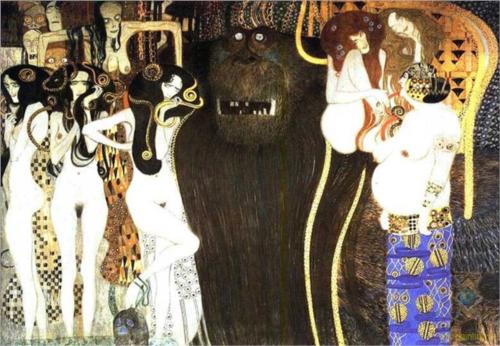
The Secession was also hosting an exhibit of the work of Thomas Locher, inspired by Jacques Derrida’s writings on Mauss and the gift–which have been enormously influential on my own scholarship. We had to rush through that exhibit, though, as the museum was closing. After exiting we wandered through the outdoor night market that lies just outside the museum.
In the two months since we returned from Vienna, I find myself stumbling into references to Vienna everywhere. Summer’s gone, but I’m still walking alongside the Danube.
The Music of Hayakawa Yoshio (3): “The Most Beautiful Thing in this World”
(In anticipation of the October 18, 2013 concert by Hayakawa Yoshio and Sakuma Masahide at the University of Chicago, over the next few weeks I will be posting a series of entries here introducing Hayakawa’s music. More information about the concert, which is free and open to the public, is available here.)

“The Most Beautiful Thing in This World??? (Kono yo de ichiban kirei na mono) is the title track from Hayakawa’s second solo album, released in 1994 on Sony Records. With music and lyrics by Hayakawa, this was the song by which he announced his return to active recording and performing after more than two decades of self-imposed exile from the music industry. During his years away from performing, Hayakawa managed a bookstore in the suburbs of Tokyo and published a number of books of essays.
You can hear the original 1994 recording of the song here:
The Most Beautiful Thing in This World
(Music and lyrics by Hayakawa Yoshio)
English translation by Michael Bourdaghs
Feel my weak heart in my fingertips
Trembling pathetically
Naked in front of you all
Curled up, wretched me.
Why do I sing these songs?
What do I want to say—and to whom?
Wish I’d been born a stronger man
But I can’t help it, this is who I am.
The most beautiful thing in this world
The thing you need the most
The vast cosmos that embraces us all
A single teardrop, life seeking life
The most beautiful thing is not somewhere out there
It waits inside of you
Be a good person, be simple and true
The heart that knows beauty is beauty
*****
Yowai kokoro ga yubisaki ni tsutawatte
Itaitashii hodo furuete iru
Minna no mae de hadaka ni natte
Chijikomatte iru mijime na boku
Naze ni boku wa uta o utau no dar??
Dare ni nani o tsutaetai no dar??
Motto tsuyoku umaretakatta
Shikata ga nai ne kore ga boku da mono
Kono yo de ichiban kirei na mono wa
Anata ni totte hitsuy?? na mono
Bokura o tsutsumu s??dai na uch?
Hitoshizuku no namida motomeau inochi
Kirei na mono wa doko ka ni aru no dewa nakute
Anata no naka ni nemutteru mono nan da
Ii hito wa ii ne sunao de ii ne
Kirei to omou kokoro ga kirei na no sa
New Fiction: “In My Room (Ganz Allein)”
My novelette (longer than a short story, shorter than a novella) “In My Room (Ganz Allein)” has just been published by Eunoia Review. It’s an online literary journal based in Singapore that presents a new piece of creative writing every day.
The title is a Beach Boys’ allusion made in two different languages. You’ll see why if you read on. Enjoy!
“In My Room (Ganz Allein)”
For Wilfred
You need the softest touch to open the door to Ken’s apartment. If you don’t hold the key just right it jams in the lock—and then you’re screwed. This afternoon Tokyo is one colossal steam bath. Ken’s hands are greased over with sweat, and the plastic keychain, a souvenir from Thailand, keeps slipping in his fingers. After a wearied day teaching English conversation, he just wants inside. He starts to panic, like a refugee halted at a border crossing. But this little story delivers a happy ending: at last, he gets the key exactly right. He rotates it ever so gently, feels the tumblers click into place and the lock spring open. Ken should call his landlord about getting the lock fixed, but the thought of explaining it all in Japanese is more than he can handle.
He slips off his black dress shoes in the entryway. A large cockroach buzzes past his nose; in Japan they have wings, kamikaze roaches. But Ken is beyond caring. He disregards the insect. From outside his balcony window, he can hear the cicadas chant their horny mating call: meen meen meen. Carry on, ye wingèd vermin of the East.
He clicks on the air conditioner and flops down at his little kitchen table. Leaning forward so his sweaty shirt won’t stick to the chair, he glances at the morning’s Japan Times, wilted across the tabletop. A photo of Ronald Reagan holds down the front page. Behind the wrinkly president stand Senator Daniel Inouye and a dozen other aging Japanese-Americans. Reagan is smiling as if he were actually pleased to sign the Civil Liberties Act of 1988, the official apology for the wartime internment camps.
(Read the rest here on Eunoia Review’s website)
The Music of Hayakawa Yoshio (2): “Salvia Flowers???
(In anticipation of the October 18, 2013 concert by Hayakawa Yoshio and Sakuma Masahide at the University of Chicago, over the next few weeks I will be posting a series of entries here introducing Hayakawa’s music. More information about the concert, which is free and open to the public, is available here.)

The Jacks broke up after releasing two studio albums, and in 1969 Hayakawa recorded his first solo album. Things That Are Cool Are Somehow So Uncool (Kakko ii koto wa nante kakko warui dar??). Released on the underground URC label, the LP received widespread acclaim, with critics in particular singling out the track “Salvia Flowers??? (????????), with music by Hayakawa and lyrics by Aizawa Yasuko, for praise. Whereas The Jacks’ music had been primarily guitar-based, for his solo debut Hayakawa switched to piano as his main instrument.
With its achingly beautiful melody and elegiac lyrics, “Salvia Flowers??? became Hayakawa’s most widely covered composition. It has subsequently been performed by numerous performers from across the popular music spectrum, ranging from Kuwata Keisuke (Southern All Stars) to Inoue Y??sui, Yuki Saori, Agata Morio, and Yamamoto Linda. It also remains a fixture of Hayakawa’s concert repertoire.
The original 1969 recording of “Salvia Flowers???:
Hayakawa performing the song with violinist Honzi on Japanese television circa 2005:
“Salvia Flowers??? (Sarubia no hana)
(Music by Hayakawa Yoshio, lyrics by Aizawa Yasuko)
English translation by Michael Bourdaghs
Always, always wanted to do it: take salvia flowers
and drop them into your room
To cover your bed in red salvia flowers
And hold you till we die
And yet, and yet: you’ve gone to another
Even though my love is deeper
Weeping, I chased you through a storm of cherry blossoms
The church bell rang untrue
The doors opened and you appeared, the false flower-bride
Threw a glance at my stunned face
Weeping, I chased you through a storm of cherry blossoms
Falling and stumbling, falling and stumbling, I ran on and on
******
Itsumo itsumo omotteta sarubia no hana o
Anata no heya no naka ni nageiretakute
Soshite kimi no beddo ni sarubia no akai hana shikitsumete
Boku wa kimi o shinu made dakishimete iy?? to
Nanoni nanoni d??shite hoka no hito no tokoro ni
Boku no ai no h?? ga suteki nanoni
Nakinagara kimi no ato o oikakete hanafubuki mau michi o
Ky??kai no kane no ne wa nante usoppachi nanosa
Tobira ga aite dete kita kimi wa itsuwari no hanayome
Hoho o kowabarase boku o chiratto mita
Nakinagara kimi no ato o oikakete hanafubuki mau michi o
Korogenagara korogenagara hashiritsuzuketa no sa
The Music of Hayakawa Yoshio (1): “Love Generation”
(In anticipation of the October 18, 2013 concert by Hayakawa Yoshio and Sakuma Masahide at the University of Chicago, over the next few weeks I will be posting a series of entries here introducing Hayakawa’s music. More information about the concert, which is free and open to the public, is available here.)

“Love Generation??? (????????????????) with lyrics and music by Hayakawa, was a stand-out track on Vacant World [Jakkusu no sekai, 1968], the celebrated debut album by The Jacks, Hayakawa’s 1960s folk-rock group. With Hayakawa’s searing vocals, Mizuhashi Haruo’s psychedelic guitar, Tanino Hitoshi’s fluid bass, and Kida Takasuke’s jazz-influenced drumming, the original recording is an excellent example of the dark, moody style of The Jacks that captivated audiences on the underground music scene of late 1960s Japan.
Okabayashi Nobuyasu, the “God of Japanese Folk Music,??? recorded a cover version of “Love Generation??? on his classic 1970 album, Leap Before You Look (Miru mae ni tobe). Hayakawa himself has also revisited this composition repeatedly during his solo career. In addition, the song provided the title for Hayakawa’s first book, a lively collection of essays first published in 1972 and still in print today.
The original Jacks’ recording of “Love Generation???:
Hayakawa’s cover of the song from his 1995 solo album Sunflower [Himawari no hana]:
“Love Generation???
(Lyrics and music by Hayakawa Yoshio)
English translation by Michael Bourdaghs
When we want to start something
We don’t want to fake being alive
So sometimes we fake being dead
That’s right: we fake being dead.
If you want to, you can fly through the sky
The swelling of joy when you feel that way
We cry as we exchange cups of a saké you can’t drink
That’s right: we exchange cups of a sake you can’t drink
It’s those things everyone says are true because they want to believe
It’s all those lofty things: those are the things you should question
Adults are supposed to be better than this
You’ll find the real adults among the children
It’s because I want to be alone
That I talk with so many people, like a fool
But deep in our words, the love—
But deep in our words, the love—
Overflows
***********
Bokura wa nani ka o shihajimey?? to
Ikiteru furi o shitakunai tame ni
Toki ni wa shinda furi o shite miseru
Toki ni wa shinda furi o shite miseru no da.
Shiy?? to omoeba sora datte toberu
S?? omoeru toki ureshisa no amari
Nakinagara nomenai sake o kawasu
Nakinagara nomenai sake o kawasu no da.
Shinjitai tame ni tadashii to omowarete iru mono koso
Subete arayuru ??kina mono o utagau no da
Otonnatte iu no wa motto suteki nan da
Kodomo no naka ni otona wa ikiten da
Jitsu wa hitori ni naritai yue ni
Baka mitai ni takusan no hito to hanasu no da
Bokura no kotoba no oku ni wa ai ga
Bokura no kotoba no oku ni wa ai ga
Ippai aru.
Natsume Soseki and the Visual Arts
Last week in Tokyo I visited the ongoing “Natsume Soseki and the World of Art” (??????????????? exhibit at the Tokyo Geijutsu Daigaku Bijutsukan, near Ueno Park. The show continues through July 7 and is well worth your while. The exhibition website (Japanese language only) is here and includes many images from the show.
It’s a big exhibit–over 200 pieces arranged across eight different rooms. The first room, “Preface,” centers on Hashiguchi Goyo’s striking Art Nouveau style illustrations and cover designs for the first edition of I Am A Cat (Wagahai wa neko de aru, 1905-6). I’ve seen most of them before, but having them displayed together alongside early sketches really brings out their wonderful strangeness.

“Chapter One” focuses on mostly European-style painting, including a number of works discussed in Soseki’s early fiction. “Chapter Two” turns its gaze on East Asian pieces, including some mentioned in various novels and stories. “Chapter Three” includes 42 works connected to the novels Kusamakura (1906), Sanshiro (1908), And Then (Sore kara, 1909) and The Gate (Mon, 1910). It includes, for example, John William Waterhouse’s 1901 oil painting “The Mermaid,” which Sanshiro and Minako encounter and discuss in Sanshiro. This room includes one painting especially created for the exhibit: Sato Eisuke’s reconstruction of “Mori no onna,” the portrait of Minako that Sanshiro gazes at in the closing pages of the novel. The style of Sato’s rendering matches my mental image of the painting described in the novel, but it seemed much too small: reading Soseki’s description of the work, I imagine an enormous panel-sized painting, but Sato’s version is less than one meter tall, I think. Here’s a video snippet:
“Chapter Four” explores Soseki’s relations with contemporary artists. The organizers have assembled a large number of works that were displayed at the 1912 “Bunten” exhibit, about which Soseki serialized an extended review essay in the Asahi newspaper. They include quotations from Soseki’s evaluation next to each of the works. Perhaps it’s just me and the strong emotional bond I feel for Soseki, but there’s something about standing in front of a painting that you know he gazed at one hundred years ago and comparing your own reaction to his. Both Soseki and I were struck by Sano Issei’s “Yukizora,” a folding screen depicting a flock of birds scattered across the withered branches of a tree, :

“Chapter Five” collects works by painters who were close to Soseki, inlcuiding Asai Chu, Nakamura Fusetsu, and Hamaguchi. I was struck by Tsuda Seifu’s 1931 portrait of Natsume Aiko (Soseki’s daughter), wearing a bright red dress and smiling broadly. There is also a striking watercolor of a chrysanthemum in the guise of a letter that Masaoka Shiki sent to Soseki in 1900.

“Chapter Six” includes 24 of Soseki’s own paintings. He was a serious amateur painter working mainly in watercolors and ink. I was curious to see that all of the works included came from the collection of Iwanami Shoten. I can understand why the various manuscript pages included in the exhibit would be in the hands of Iwanami, Soseki’s publisher. But why do they also own many of his artworks, which were not meant for publication or public display? The exhibit concludes with a room that covers more of the elegant artwork from the early editions of Soseki’s books.
The museum is a short walk from Ueno Park, the setting for a number of scenes in Soseki’s fiction. We are in a stretch now where every year marks the centennial anniversary of important works by Soseki, and the urge to try to retrace his footsteps is only natural. See if you can resist the urge to stand alone in front of “Mori no onna” and whisper silently, “Stray sheep.”
Remembering Kyoko Iriye Selden (1936-2013)
This afternoon in Ithaca they held a memorial service for Kyoko Iriye Selden. Unfortunately, my responsibilities here in Chicago kept me from attending. I had the privilege of studying with Selden-sensei when I was a graduate student at Cornell. She was a great teacher, scholar, and translator. More than that, she was a warm, graceful, witty human being. I have been thinking of her often since the sad news of her passing away this past January.
I remember her fourth-year Japanese class, a literature seminar disguised as a language class. I took it my first year at Cornell. In one of the stories we read that year, I came across the following phrase:???????????. In my arrogance, I didn’t bother looking it up in a dictionary. Given the repeated use of the oni radical in all four characters, it obviously meant some kind of demon or ogre. I figured that was good enough for my purposes.
In class Selden-sensei happened to ask me to read aloud the passage containing those four characters. When I got to that phrase, I had to ask her the pronunciation: chimi mouryou. She told me it meant the evil spirits found in mountains and rivers, and then she asked me if I had had trouble finding it in the dictionary. I confessed that I hadn’t even tried: the phrase seemed too obscure to be worth the bother. After all, what were the odds that I would ever encounter it again?
The next class meeting Selden-sensei asked me to write chimi mouryou on the blackboard. Of course, I couldn’t. She sighed for effect. Then she handed me a photocopy of a page from another short story and asked me to read it. Lo and behold, there it was: ??????????. And then she handed me a photocopy of a page from another story and told me to read it. ?????????? again. And then another, and then another. Finally, with a playful grin, she said, “I’m just trying to show you how utterly common chimi mouryou is.”
I went home that evening and spent half an hour practicing writing out those four characters: ??????????. I was prepared for her the next class meeting. But she never mentioned it again.
One of my homework projects for that class was a translation of Higuchi Ichiyo’s 1895 short story, “Kono Ko” (This Child). Selden-sensei as always read through my draft with remarkable care, correcting not only the Japanese but also the English style, making subtle suggestions for how to render the figurative language with more precision. Her attention to detail transcended the realm of scholarly precision; it became an ethical question. She was teaching by example about the responsibilities of being a scholar and a teacher.
Nearly twenty years later, she contacted me to ask if she could include that translation in the volume More Stories by Japanese Women Writers that she was co-editing with Mizuta Noriko. I couldn’t believe that she remembered my homework assignment after all those years. Then again, I knew that she had always treated with serious attention even the assignments of a first-year graduate student too lazy and conceited to look up vocabulary items. That was the kind of teacher she was; that was the kind of person she was.
Upcoming Japan-related Events at the University of Chicago
Apologies for the dearth of posts recently: it’s been a busy couple of months. The coming weeks and months promise to be just as busy, with many exciting Japan-related events on the horizon here at the University of Chicago. If you’re in the area, please consider joining us for some of the following events:
March 11: William Marotti (Associate Professor, History, UCLA) will be giving a public lecture on “Perceiving Politics: Art, Protest, and Everyday Life in Early 1960s Japan” (5:00 p.m., Wieboldt 408). He’ll discuss his new book, Money, Trains, and Guillotines: Art and Revolution in 1960s Japan (Duke University Press, 2013).
March 15-16: Remediations II: A Japan Anthro Workshop. Michael Fisch has organized this exciting event, featuring presentations by a number of up-and-coming Japan scholars. I’ll be a discussant for Panel 2: “Rethinking the War Machine: Remediations of Violence.”
April 22: 2013 Najita Distinguished Lecture in Japanese Studies with Ueno Chizuko(5:00 p.m., International House). A public lecture by the respected sociologist and influential feminist critic, one of Japan’s leading public intellectuals.
April 25-26: “The Cold War in East Asia,” a conference organized by our graduate students featuring a number of guest speakers. I’ll participate as a respondent for one of the panels.
May 10-11: “The Russian Kurosawa,” an innovative event organized by Olga Solovieva that brings together specialists in Russian literature, Japanese film, and other disciplines to reconsider Kurosawa Akira’s film adaptations of Russian literary works. The event will include free screenings of several of Kurosawa’s films.
Spring quarter will also see screenings and events surrounding the films produced and distributed by Art Theater Guild, the primary force in independent Japanese cinema during the 1970s and 80s.
October 18-20: The Association for Japanese Literary Studies Annual Meeting: Performance and Japanese Literature. The call for papers and other information are available here.
