

Last Friday’s Concert: Hayakawa Yoshio and Sakuma Masahide
Thanks to all who turned out for last Friday’s concert at International House, University of Chicago, by Hayakawa Yoshio and Sakuma Masahide. It was the keynote performance for the 2013 Association for Japanese Literary Studies Annual Meeting. The theme of the conference was “Performance and Japanese Literature,” and the concert turned into a powerful instance of performance in all of its aspects: ephemeral, emotional, communal. Many in the audience ended up in tears, including those who spoke no Japanese and were responding solely to the music itself. The concert ended with three standing ovations and two encores.
In the weeks leading up to the event I wrote a series of blog entries here and on the conference website, introducing the performers and their music. I found it a struggle all along: song lyrics never submit willingly to translation, and I often found myself flailing as I tried to find apt words to convey what the pieces were doing. For example, I described Hayakawa’s composition “Tosan e no tegami” (Letter to my father) as an act of musical mourning. That never felt quite right, but I couldn’t find better words to name the performance the song carries out.
Watching it and the other pieces being played last Friday night, though, it hit me. The songs aren’t about mourning; they are about the struggle that art mounts against death. I didn’t feel it was my place to announce here or in introducing the band that Sakuma has been diagnosed with terminal stomach cancer and that this could turn out to be one his final live performances (Sakuma has himself been very frank about his illness on his own blog, where he writes movingly about the difficulties he has faced since the discovery of a brain tumor this past summer: often his hands won’t move the way he wants them to along the neck of his guitar). But Hayakawa mentioned the illness from the stage on Friday evening and turned the concert into a tribute to his longtime collaborator.
Suddenly, the songs took on a new hue. That magnificent coda in?”Karada to uta dake no kankei” (The direct relation between body and song), a cover of a song originally done by hi-posis but that Hayakawa has very much made his own, never felt so powerful. The pounding, repetitive music of the early verses, with their overtly sexual lyrics depicting music almost as a kind of animal rutting, suddenly shifts to a sweet, soaring melodic line, and Hayakawa sings with passion “Uta dake ?a nokoru” (only the song remains: in other words, the only thing that will get out alive is the music itself). It’s always a cathartic moment, but under the circumstances on Friday it became unforgettable. Watching Hayakawa’s face as he sung and Sakuma’s hands as he played, the message was clear: we will all die soon enough, but as long as we are playing music, we’re still alive. And even after death wins out over us individually, the music will live on as a trace of our struggle.
It’s a theme Hayakawa returns to over and over in his compositions, especially in those from the years since his 1994 return to music. Art and eros are our only flimsy weapons in the fight to hold death at bay. Death will surely win in the end, but we will continue singing until then, and if we are lucky the song will persist after we are gone. It’s a simple message and not a particularly new one. Yet on Friday night, we could feel its truthfulness in our flesh, in the goosebumps and tears that the music summoned up.
The set list:
1) ??????????????????(Himawari no hana; Sunflowers): title song from Hayakawa’s 1995 solo album
2) ?????????????? (Akairo no wanpiisu; Red dress)
3)???????????(Datenshi rokku; Fallen angel rock): one of two JACKS’ songs in the set
4) ???????????? (Sarubia no hana: Salvia Flowers): Hayakawa’s best-known composition
5)?????? (H=Japanese slang for sexual desire)
6)???????????????????(So to utsu no aida de; Between sadness and melancholy)
7) ????????????????? (Tosan e no tegami; Letter to my father)
8)??????????????????????(Karada to uta dake no kankei; The direct relation between body and song)
9)?????????????Aoi tsuki, Blue moon): a new song.
10) ??????????????(Itsuka; Sometime)
11)???????????????????? (Karappo no sekai; Vacant world): JACKS’s debut single from 1968
First encore:
??????????????????????????(Kono yo de ichiban kirei na mono; The most beautiful thing in the world): title track from Hayakawa’s 1994 comeback solo album
Second encore:
?????????????????????????????(Kimi de nakucha dame sa; Nobody but you)

My Viennese Summer
I hope that you had a good summer, wherever and however you spent it. Classes at UChicago start Monday, so let me try to recap my own summer. For me, 2013 was the summer of Vienna, in imagination and reality.
The July 31 free concert by the Grant Park Orchestra in Millennium Park helped get things started. The program consisted of a single piece: the rarely performed Symphony No. 2 by Viennese composer Antonio Bruckner. It’s a delightfully sweet composition, especially in the slow movement, and the performance on a fine summer evening captured it quite gracefully. Mentally I was already walking alongside the Danube, the Blue Danube.
Around the same time, I began my background reading: two fine cultural histories of Vienna: Frederic Morton’s A Nervous Splendor: Vienna 1888-1889 (1980) and Carl E. Schorske’s Fin–de-siècle Vienna: Politics and Culture (1980). From there, I moved onto Stefan Zweig’s The World of Yesterday (1942), an elegiac memoir of the novelist’s life in Vienna that he completed in exile in South America, the day before he committed suicide. I also read Vienna Idylls, a collection of short stories by Arthur Schnitzler. It’s easy to understand why Freud loved Schnitzler: his fiction throbs with repressed desires and unspoken impulses. His characters say one thing, but clearly mean something entirely different. They think they desire one object, but obviously covet the exact opposite. Modernity in a nutshell.
On the morning of August 6, we arrived at the airport in Vienna, took the express train into the city and then the subway to Graben. The moment we emerged at the top of the escalator from the Stephansplatz underground and into the ancient plaza was stunning–as was the heat. We checked into our hotel and began a dazed four-day visit. The highlights for me were visiting Berggasse 19–the apartment where Sigmund Freud lived and worked from 1891 until 1938, when he went into exile after the Nazis took over Austria–and the Prater amusement park, home of the famous Ferris wheel. I’ve always loved carnivals and fairs (a few weeks after Vienna we made our annual pilgrimage to the Minnesota State Fair), and I especially liked Prater because it was the only time during our visit to Austria that we mingled with working class, immigrants, teen-agers: ordinary folks, out like us for a good time on a pleasant summer night.
Another highlight was the Secession museum, where we spent half an hour in the company of Klimt’s Beethoven freize.
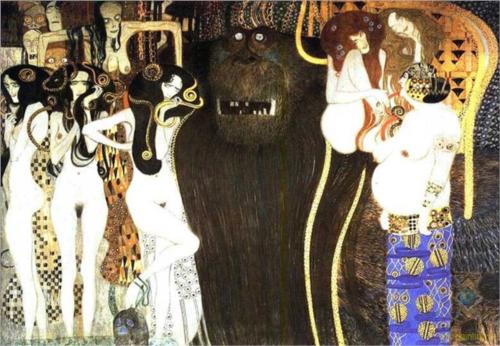
The Secession was also hosting an exhibit of the work of Thomas Locher, inspired by Jacques Derrida’s writings on Mauss and the gift–which have been enormously influential on my own scholarship. We had to rush through that exhibit, though, as the museum was closing. After exiting we wandered through the outdoor night market that lies just outside the museum.
In the two months since we returned from Vienna, I find myself stumbling into references to Vienna everywhere. Summer’s gone, but I’m still walking alongside the Danube.
New Fiction: “In My Room (Ganz Allein)”
My novelette (longer than a short story, shorter than a novella) “In My Room (Ganz Allein)” has just been published by Eunoia Review. It’s an online literary journal based in Singapore that presents a new piece of creative writing every day.
The title is a Beach Boys’ allusion made in two different languages. You’ll see why if you read on. Enjoy!
“In My Room (Ganz Allein)”
For Wilfred
You need the softest touch to open the door to Ken’s apartment. If you don’t hold the key just right it jams in the lock—and then you’re screwed. This afternoon Tokyo is one colossal steam bath. Ken’s hands are greased over with sweat, and the plastic keychain, a souvenir from Thailand, keeps slipping in his fingers. After a wearied day teaching English conversation, he just wants inside. He starts to panic, like a refugee halted at a border crossing. But this little story delivers a happy ending: at last, he gets the key exactly right. He rotates it ever so gently, feels the tumblers click into place and the lock spring open. Ken should call his landlord about getting the lock fixed, but the thought of explaining it all in Japanese is more than he can handle.
He slips off his black dress shoes in the entryway. A large cockroach buzzes past his nose; in Japan they have wings, kamikaze roaches. But Ken is beyond caring. He disregards the insect. From outside his balcony window, he can hear the cicadas chant their horny mating call: meen meen meen. Carry on, ye wingèd vermin of the East.
He clicks on the air conditioner and flops down at his little kitchen table. Leaning forward so his sweaty shirt won’t stick to the chair, he glances at the morning’s Japan Times, wilted across the tabletop. A photo of Ronald Reagan holds down the front page. Behind the wrinkly president stand Senator Daniel Inouye and a dozen other aging Japanese-Americans. Reagan is smiling as if he were actually pleased to sign the Civil Liberties Act of 1988, the official apology for the wartime internment camps.
(Read the rest here on Eunoia Review’s website)
Natsume Soseki and the Visual Arts
Last week in Tokyo I visited the ongoing “Natsume Soseki and the World of Art” (??????????????? exhibit at the Tokyo Geijutsu Daigaku Bijutsukan, near Ueno Park. The show continues through July 7 and is well worth your while. The exhibition website (Japanese language only) is here and includes many images from the show.
It’s a big exhibit–over 200 pieces arranged across eight different rooms. The first room, “Preface,” centers on Hashiguchi Goyo’s striking Art Nouveau style illustrations and cover designs for the first edition of I Am A Cat (Wagahai wa neko de aru, 1905-6). I’ve seen most of them before, but having them displayed together alongside early sketches really brings out their wonderful strangeness.

“Chapter One” focuses on mostly European-style painting, including a number of works discussed in Soseki’s early fiction. “Chapter Two” turns its gaze on East Asian pieces, including some mentioned in various novels and stories. “Chapter Three” includes 42 works connected to the novels Kusamakura (1906), Sanshiro (1908), And Then (Sore kara, 1909) and The Gate (Mon, 1910). It includes, for example, John William Waterhouse’s 1901 oil painting “The Mermaid,” which Sanshiro and Minako encounter and discuss in Sanshiro. This room includes one painting especially created for the exhibit: Sato Eisuke’s reconstruction of “Mori no onna,” the portrait of Minako that Sanshiro gazes at in the closing pages of the novel. The style of Sato’s rendering matches my mental image of the painting described in the novel, but it seemed much too small: reading Soseki’s description of the work, I imagine an enormous panel-sized painting, but Sato’s version is less than one meter tall, I think. Here’s a video snippet:
“Chapter Four” explores Soseki’s relations with contemporary artists. The organizers have assembled a large number of works that were displayed at the 1912 “Bunten” exhibit, about which Soseki serialized an extended review essay in the Asahi newspaper. They include quotations from Soseki’s evaluation next to each of the works. Perhaps it’s just me and the strong emotional bond I feel for Soseki, but there’s something about standing in front of a painting that you know he gazed at one hundred years ago and comparing your own reaction to his. Both Soseki and I were struck by Sano Issei’s “Yukizora,” a folding screen depicting a flock of birds scattered across the withered branches of a tree, :

“Chapter Five” collects works by painters who were close to Soseki, inlcuiding Asai Chu, Nakamura Fusetsu, and Hamaguchi. I was struck by Tsuda Seifu’s 1931 portrait of Natsume Aiko (Soseki’s daughter), wearing a bright red dress and smiling broadly. There is also a striking watercolor of a chrysanthemum in the guise of a letter that Masaoka Shiki sent to Soseki in 1900.

“Chapter Six” includes 24 of Soseki’s own paintings. He was a serious amateur painter working mainly in watercolors and ink. I was curious to see that all of the works included came from the collection of Iwanami Shoten. I can understand why the various manuscript pages included in the exhibit would be in the hands of Iwanami, Soseki’s publisher. But why do they also own many of his artworks, which were not meant for publication or public display? The exhibit concludes with a room that covers more of the elegant artwork from the early editions of Soseki’s books.
The museum is a short walk from Ueno Park, the setting for a number of scenes in Soseki’s fiction. We are in a stretch now where every year marks the centennial anniversary of important works by Soseki, and the urge to try to retrace his footsteps is only natural. See if you can resist the urge to stand alone in front of “Mori no onna” and whisper silently, “Stray sheep.”
Upcoming Japan-related Events at the University of Chicago
Apologies for the dearth of posts recently: it’s been a busy couple of months. The coming weeks and months promise to be just as busy, with many exciting Japan-related events on the horizon here at the University of Chicago. If you’re in the area, please consider joining us for some of the following events:
March 11: William Marotti (Associate Professor, History, UCLA) will be giving a public lecture on “Perceiving Politics: Art, Protest, and Everyday Life in Early 1960s Japan” (5:00 p.m., Wieboldt 408). He’ll discuss his new book, Money, Trains, and Guillotines: Art and Revolution in 1960s Japan (Duke University Press, 2013).
March 15-16: Remediations II: A Japan Anthro Workshop. Michael Fisch has organized this exciting event, featuring presentations by a number of up-and-coming Japan scholars. I’ll be a discussant for Panel 2: “Rethinking the War Machine: Remediations of Violence.”
April 22: 2013 Najita Distinguished Lecture in Japanese Studies with Ueno Chizuko(5:00 p.m., International House). A public lecture by the respected sociologist and influential feminist critic, one of Japan’s leading public intellectuals.
April 25-26: “The Cold War in East Asia,” a conference organized by our graduate students featuring a number of guest speakers. I’ll participate as a respondent for one of the panels.
May 10-11: “The Russian Kurosawa,” an innovative event organized by Olga Solovieva that brings together specialists in Russian literature, Japanese film, and other disciplines to reconsider Kurosawa Akira’s film adaptations of Russian literary works. The event will include free screenings of several of Kurosawa’s films.
Spring quarter will also see screenings and events surrounding the films produced and distributed by Art Theater Guild, the primary force in independent Japanese cinema during the 1970s and 80s.
October 18-20: The Association for Japanese Literary Studies Annual Meeting: Performance and Japanese Literature. The call for papers and other information are available here.
Reading Bob Mould
I recently finished reading Bob Mould’s See A Little Light: The Trail of Rage and Melody. Most of the reviews I read praised the book, but complained that it focused too little on Mould’s days as leader of the seminal hardcore band Hüsker Dü and too much on his recent activities, especially his description of growing into the identity, social and sexual, of a mature gay man.
My own response was the opposite. I appreciated the chapters on Hüsker Dü–especially since they allowed me to relive a part of my youth. I never became a huge Hüsker Dü fan, but I was a year behind Mould at Macalester College, lived in the same dorm and even had one class with him (“Introduction to Sociology,” about which I remember nothing else). I remember in particular one fiery early performance by the band at a kegger in the basement of Doty dorm. I shared many of the places Mould writes about (Cheapo’s Records, Northern Lights, Ron’s Randolph Inn, Seventh Street Entry, etc.) and I knew a number of the people that show up in his story. Reading the book was a nostalgic experience, and of course it got me digging out my copies of “Flip Your Wig” and “Warehouse.”
But it was the later chapters that really fascinated me. In part the appeal came from the sympathetic insider’s account of a scene that I don’t know: Mould helped me get a feel for what everyday life is like in a different corner of the universe. Even more than that, though, I was struck by his description of what it means to grow up, to take on and live out fully the identity that one has pieced together. The book is a real anomaly: a thoughtful, fearless account of what it means for a rocker to become a middle-aged adult. We’re not all rock stars, but we all grow old, and Mould writes well about how to do that with grace, joy, and intelligence.
I am sorry, however, that he left out my favorite Hüsker Dü story. There was a thriving underground music scene in the Twin Cities circa 1982-3, and it was starting to get mainstream media attention. Local television reporters, after getting their vaccinations updated and donning protective gear, would pay hesitant visits to the subculture and report back in half-curious, half-terrified fashion about what was happening. So the mass audience learned that something was going on in the clubs of downtown Minneapolis, but the knowledge came with real anxiety. Did we have punks in Minnesota? Would they act rude and say bad words? Were they like us?
At the time WCCO-AM radio was the most mainstream of mainstream media. One of the old clear-channel stations allowed to broadcast at 50,000 watts, it dominated the airwaves. WCCO utterly owned the local radio audience ratings–at its peak, it had twice the listeners of its nearest competitor. If you grew up in Minnesota in the 1960s and 70s, like me, you can probably still remember all of the announcers, the farm reports, the Boone and Erickson comedy routines, etc. (A nice sample of air checks is available here).
WCCO’s position had begun to slip by the early 1980s, but it was still a powerhouse. One day in 1985 a WCCO deejay risked playing the latest record from the celebrated local punk band, Hüsker Dü. It was on one of the station’s afternoon shows aimed at housewives, as I recall, and the record the deejay chose to play was the cover version of “Love is All Around,” the opening theme song from the old “Mary Tyler Moore Show.” The station’s phone bank lit up: calls flooded in from around the state. People absolutely loved the record. Hüsker Dü might be punk, but by taking up the theme song from the beloved “Mary Tyler Moore Show” (set in Minneapolis and a source of immense pride for WCCO’s audience), the band showed they were part of “us.” The cover was an affectionate joke, and WCCO’s audience got it. The station ended up having to play the record over and over again during the following weeks. All over Minnesota, housewives and their preschool offspring got their first exposure to hardcore punk, all thanks to “The Good Neighbor” (the station’s promotional slogan), WCCO-AM.
Bringing in 2013 with Buddy Guy
For Christmas I gave Satoko two tickets to the January 3 opening night of Buddy Guy’s annual homestand at his club, Buddy Guy’s Legends, here in Chicago. It was as much a present for myself as for her, of course–assuming she let me use the second ticket. Which she did.
The last time I saw Guy play live was back in the early 1980s. He and Junior Wells did a gig at Macalester College when I was an undergraduate. Macalester used to regularly bring in Chicago blues acts for its weekend dances: I remember seeing James Cotton, Luther Allison, Koko Taylor, and Albert Collins, among others. In addition, a number of local bars in the Twin Cities used to bring in big names–Muddy Waters, John Lee Hooker, Willie Dixon…. Growing up in Minnesota in the 1970s and 80s, it was easy to get an education in blues music from the masters of the form.
Buddy Guy may be 76 years old, but he performs with the energy and speed of someone half his age. Resplendent in a bright red suit, he played some wicked, lightening-fast runs that reminded us of how much Jimi Hendrix copped from him. But he also did a nice acoustic set, and the evening provided a kind of history of R&B music, with tributes to Ray Charles, Marvin Gaye, John Lee Hooker, Albert King and others. Many of Guy’s family and friends were in the house, and at various points in the evening he brought up two daughters and one son to share the stage with him.
The club was packed. Guy did all of his patented shtick, too, playing the guitar behind his back and with a drumstick, leaving the stage to walk to length of the barroom and even outside onto the street, tossing guitar picks to fans. He told stories and jokes, made funny faces, and flirted. Sometimes, his showmanship gets in the way of his performance, but last night his musical chops–both his guitar playing and his singing–were the focus. He played loud, he played quiet; he played fast, he played slow. Highlights included “74 Years Young,” “She’s Nineteen Years Old,” “Hoochie Koochie Man,” “Someone Else Is Steppin’ In (Slippin’ Out, Slippin’ In)” (the latter became an audience sing-along), “Damn Right I Got the Blues,” and a moving version of “Feels Like Rain.” He closed with a lovely rendition of his recent song, “Skin Deep.”
When he left the stage at the end of the set he walked right past us on his way to the merchandise counter. Both Satoko and I shook his hand. My 51-year-old ankles and knees were sore from standing all night, but the 76-year-old legend had been on his feet all night, too, and he looked like he could keep going for a few more hours.
It was well past midnight when we hailed a taxi and headed for home. What a nice way to begin the year.
Looking Back on 2012 (Part Two)
July brought many exciting developments. I was promoted to full Professor and became chair of my department at the University of Chicago. The Japanese translation of Sayonara Amerika, Sayonara Nippon came out from Byakuya Shobo. At around the same time, the discovery I helped make of some previously unknown 1950 Sacramento concert recordings by Misora Hibari, Kasagi Shizuko, Yamaguchi Yoshiko and many other Japanese singing stars became big news in Japan. I was apparently a featured item on television “wide shows” for a couple of days; I’m told that at least one of the shows introduced me with a photograph that was not actually of me. The Japanese edition of the book was well received, too; dozens of newspapers and magazines ran favorable reviews.
The whole family flew to Tokyo in late July. I spent a couple of days doing press interviews at my publishers’ offices in Takadanobaba. On July 29, Satoko and I were able to participate in one of the largest anti-nuclear demonstrations of the year, a march that started from Hibiya Park and ended up surrounding the Diet building. We celebrated the children’s birthdays up in Sendai with Satoko’s parents. With the help of a reporter from the Kyodo Tsushin wire service, I was able to get a copy of the 1950 wire recording of her Sacramento concert to 92-year-old Yamaguchi Yoshiko, who gave an interview about how delighted she was to hear it. As a result, once again I showed up in newspapers across Japan.
We returned to Chicago in early August. I recorded a segment for public radio’s “To the Best of Our Knowledge,” which was broadcast nationally later in the month (you can listen online here). We brought the whole family to a terrific play,”The Death of Harry Houdini,” at the House Theater. We ran up to Minnesota again to celebrate what would have been my father’s 75th birthday on August 15, and while there I saw another ballgame at Target Field. I also got to see one of my old favorite local bands, the Flamin’ Oh’s, play a show at Mears Park in downtown St. Paul. Back in Chicago at the end of the month, we attended the opening night “Tribute to Ella” with Dee Alexander, Frieda Lee, and Spider Saloff at the Chicago Jazz Festival. I returned again on the last day of the festival to catch stellar sets by the Steve Coleman Group and Pierre Dørge And The New Jungle Orchestra–two more favorite musical discoveries of the year.
In September things started gearing up in my new role as department chair, but on a stormy night we saw Bruce Springsteen give a fine concert up at Wrigley Field, and when the Twins swung through town early in the month I ran over to New Comiskey Park to take in a game. Late in the month I filled my car with grad students and drove to Kalamazoo for the Midwest Conference on Asian Affairs meeting at Western Michigan University.
Classes started in October. I taught two seminars this past fall–one on Japanese literary discourses of “furusato” (hometown), the other on Japanese cultures of the Cold War. As usual, I learned a great deal from the students in both. Extracurricular activities slowed down as I resumed full-time teaching, of course, but I still managed to get out now and then. In early October, I saw a nice set by guitarist Wayne Krantz at Martyr’s and later in the month caught an intriguing performance by shamisen composer Kimura Shunsuke. In October, I attended the Association for Japanese Literary Studies meeting at Ohio State, reconnecting with many old friends and meeting some new ones. I also enjoyed the opportunity to make a presentation about the 1950 wire recordings at the annual Humanities Day celebration here on campus in Hyde Park.
We had a quiet Thanksgiving at home, with me preparing the turkey as usual. In December, we enjoyed a show by Leo Kottke up at SPACE in Evanston, as well as a terrific performance of Barber’s Violin Concerto and Shostakovich’s Tenth Symphony by the CSO. I made another trip to Los Angeles to give a talk at UCLA and to film an interview about the 1950 wire recording of Misora Hibari for a television special which was broadcast in Japan on the BS-TBS network on December 7. We spent Christmas with family in Minnesota, quiet and relaxing. On Boxing Day, we went ice skating with a big group of my cousins and their children.
Later today we’ll bring our 2012 cultural calendar to a close by attending the acclaimed production of “Annie” at the Paramount Theater in Illinois: the last few years, our family has made a tradition of attending a musical in the week between Christmas and New Years. We also have tickets to see the opening night of Buddy Guy’s annual stand at his own blues club downtown later this week, and we’re off to Second City a few days after that for some comedy.
It really has been a blessed year for us: writing this up has helped remind me how lucky I am. I’m surrounded by a supportive family, wonderful friends and colleagues, students who keep me on my toes, and a city that bustles with creativity and energy. As usual, I have compiled a long list of New Years’ resolutions, but I won’t bore you with those. Suffice it to say that I am looking forward to 2013.
Let me end by wishing you joy, peace, and health in 2013. Thanks for stopping by.
Looking Back on 2012 (Part One)
I have several projects with looming year-end deadlines. I really should be working on those this morning. Which, of course, makes this an excellent time to devote instead to an update here. 2012 is fast winding down. What kind of year was it?
A fine and memorable one, thank you. Not without its bumps and bruises, of course, but those just help remind me that I’m alive. I end the year feeling gratitude and hope.
The first half of 2012 found me on sabbatical. In early January, I flew to Seattle for the MLA convention. I saw old friends, sat in on some good panels, caught the film “The Descendants” in a cinema across from the hotel–and accepted the Scaglione Prize for the translation I co-edited of Natsume Soseki’s Theory of Literature and Other Critical Writings. Later that month, I flew up to Ann Arbor to participate in a faculty workshop, and a week later I presented a talk at another faculty seminar at Northwestern University. The month ended with Satoko and I enjoying a performance by Westside blues legend Eddy “The Chief” Clearwater at SPACE, the little-club-that-could up in Evanston.
In February, we caught Ricardo Muti conducting the CSO in Franck’s Symphony in D minor and then, a few days later, I attended the University of Chicago Folk Festival, featuring Billy Boy Arnold. The most exciting event of the month: my book, Sayonara Amerika, Sayonara Nippon: A Geopolitical Prehistory of J-Pop, came out from Columbia University Press. I heard many nice things about it from people–to the point that I started to worry that it must not be very good. If something you write doesn’t piss anyone off, how interesting can it be? But later I heard through the grapevine that a number of senior scholars in my field hated it. I felt reassured. In late February DePaul University hosted a fun workshop based on the book for Chicago public school teachers.
On the first day of March we watched Pierre Boulez lead the CSO in a wonderful performance of Mahler’s Das Lied von der Erde. The next morning I was off to NYC for meetings. Then on March 10-11 I co-hosted a conference in honor of my colleague, Norma Field, who retired at the end of the 2011-12 academic year. “What March 11 Means to Me” brought together an amazing group of public intellectuals from Japan for personal and philosophical reflections on the first anniversary of the Tohoku earthquake, tsunami, and nuclear disaster: Amamiya Karin, Komori Yoichi, Ryusawa Takeshi, Takahashi Tetsuya, and Yokoyu Sonoko. The following week, I traveled to Toronto for the AAS annual meeting, where I chaired a roundtable discussion on the 1950 wire recordings of Japanese performers in concert in Sacramento (more on those anon).
In April, I was back in NYC for a lecture at Columbia University. While there, I saw the acclaimed revival of “Death of a Salesman” with Philip Seymour Hoffman and caught up with a few old friends. Back in Chicago, we attended a lively concert by Rodrigo y Gabriela and a fine performance by the Alvin Ailey dance company a few days later. Later in the month, I drove up to the Twin Cities to visit family and friends, catching a Twins game while there and a Beloit Snappers minor-league game on the drive home. During the month, I also finished up an article on Natsume Soseki’s conception of world literature, which appeared in the May/June issue of the Iwanami Shoten journal Bungaku.
On May Day I joined the protest march that started out from Union Park and made its way past the site of the Haymarket Massacre (the historical origin of May Day) before ending at a rally downtown. A few days later, we caught a live performance by one of my favorite musical discoveries of the year: Kids These Days. The group manages to combine rock, funk, jazz, and hip hop and make it all work; their debut album Traphouse Rock came out later in the year and was one of my favorite records of 2012.
Later in May I attended the Atomic Age II conference at Chicago. It featured a keynote address from Koide Hiroaki, one of the most important critics of Japan’s “nuclear village.” The next day, we joined a group to visit the nature preserve in the western suburbs where the remains of Chicago Piles 1 and 2 (the world’s first nuclear reactors) are buried. Later in the month we caught a surprise cameo appearance by Ray Davies at a public television benefit concert, and then I was off to Tokyo for a quick one-week visit. During that trip, I attended the May sumo tournament, met a number of scholars, visited libraries and bookstores, and stopped by an exhibit of photographs by Mike Nogami. After coming back to Chicago, I survived the NATO conference shut-down of the city, dragged the kids to the reunited Beach Boys concert at the Chicago Theater, and enjoyed a Millenium Park performance by Kelly Hogan (another key musical discovery of the year). We ended the month by catching Court Theater’s production of “Angels in America” with Larry Yando’s memorable turn as Ray Cohn.
As June began, I flew to Los Angeles to join in the celebration of the twentieth anniversary of the UCLA Terasaki Center for Japanese Studies. It was lovely to catch up with old friends from UCLA, and while there I got to meet and chat briefly with one of my childhood heroes, Daniel Inouye (RIP, Senator Inouye). It turned out that he was one of the 442nd veterans involved in inviting Misora Hibari to Hawaii in 1950 for a charity concert–which led in turn to the 1950 Sacramento concert recordings. Another quick trip to Minnesota followed, and I was back home to catch the last day of the Chicago Blues Festival, including an uplifting headliner set by Mavis Staples. During June we also caught the CSO a couple times, including an eye-opening public rehearsal led by Ricardo Muti, and we visited the Roy Lichtenstein exhibit at the Art Institute. But the cultural highlight of the month was the acclaimed production of “The Iceman Cometh” at the Goodman Theater, with an ensemble cast so strong that the supposed stars, Brian Dennehy and Nathan Lane, mostly just blended into the scenery.
July is when things really got busy. I’ll write about the second half of the year tomorrow. In the meantime, I really should get hopping on those year-end projects….
This and That
Apologies for the lack of updates these last two months. Not only have I returned to teaching from my sabbatical, I’ve also become department chair. Life is busy, in other words–but it keeps me off the streets.
This has come up rather suddenly, but I’ll be giving a talk at UCLA next week (Friday, November 16) on “Tokyo Boogie Woogie in California: The 1950 Sacramento Recordings in Japanese and Japanese-American Cultural History” (details available here). In the presentation, I’ll introduce the collection of 1950 concert recordings of Japanese musicians (Misora Hibari, Kawada Haruhisa, Yamaguchi Yoshiko, Watanabe Hamako, Kasagi Shizuko, among others) that I helped authenticate and that were in the news in Japan this past summer (see, for example, here and here). The man who discovered the recordings has now donated the entire collection to the UCLA library. While in Los Angeles, I’ll also be filming an interview for a television special about the recordings that will air later this year. I’ll post details about broadcast times when they become available.
I was also recently a guest on the NPR radio program “To the Best of our Knowledge,” talking about my book, Sayonara Amerika, Sayonara Nippon: A Geopolitical Prehistory of J-Pop. You can listen to or download my segment here. And don’t forget about the online companion for the book that I’ve put together: I’ve heard from a few people who are teaching the book this all that the webpage was very useful.
The Japanese translation of the book continues to do very well, with nice reviews coming out in many magazines and newspapers?(for example, here and here).
In the meanwhile, I am moving on to other scholarly projects: co-editing a two-volume series of new scholarly essays and translations related to early postwar Japanese literary criticism, finishing up a translation of Karatani Kojin’s magnum opus The Structure of World History (Sekaishi no kozo), and returning to a longstanding project that involves rethinking Natsume Soseki in relation to the problems of modern property regimes and world literature.
I’ll try to blog here a little more regularly in the coming months, too. It keeps me off the streets–the wild, wild streets.
